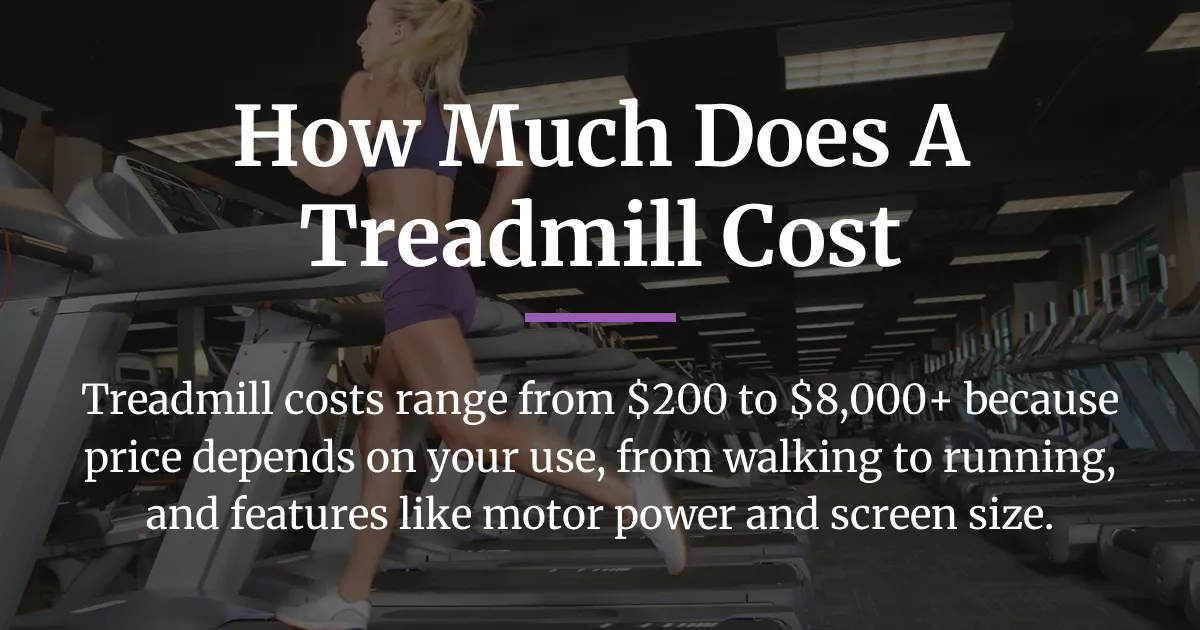
You ask a simple question: how much does a treadmill cost? The honest answer is not one number. It is a range that starts around two hundred dollars and can soar past eight thousand. Your true cost is set by what you plan to do with it. This guide will give you the full price picture and the framework to find your number.
The Treadmill Price Spectrum: From Basic Walks to Gym-Grade Runs
The market offers a treadmill for every wallet. But the price tag tells a story about what the machine can do. You must understand this landscape first.
At the very bottom, near $200, you find manual treadmills. These devices have no motor. You power the belt with your own steps. They are for walking only and often lack incline features.
The next category is the motorized home treadmill. This is where most people shop. The starting range for a durable machine you can run on begins near $1,000. The average cost for a decent, reliable model sits right around that mark.
Mid-range models cost between $1,500 and $3,000. They offer more power, better cushioning, and longer decks. These are for regular runners who want a comfortable, stable experience.
High-end home and commercial-grade treadmills start above $3,000. They can cost $8,000 or more. These machines boast the strongest motors, the largest running surfaces, and features meant for heavy daily use.
Do not forget the under-desk treadmill. As noted in search results, these mostly cost $200 to $600. They are meant for walking while you work. Their lifespan is shorter, often between six months and a few years.
What Each Price Tier Actually Delivers
A $300 treadmill from a big-box store is a product of simple electronics. It might serve a very light walker for a short time. But for running, it lacks the needed build quality.
The jump to the $1,000 mark brings a critical change. You get a motor with consistent power. You get a deck built to handle impact. This is the minimum for a machine that will last.
Spending $2,000 often gets you a best seller model with added conveniences. These include heart rate monitors and easy-reach buttons. The machine feels more substantial underfoot.
When you pass $3,000, you enter the realm of luxury fitness products. Think of a huge touchscreen or interactive training programs. These are leisure amenities that enhance the experience but are not required for a good workout.
What Actually Determines Your Treadmill’s Price Tag
The price is not random. It is a direct result of engineering choices. Each choice answers a specific need from the user. Knowing this lets you see why costs vary.
The motor is the heart of the machine. Its power is measured in horsepower. A walker may get by with less horsepower. A runner needs more power for a smooth, quiet ride at higher speeds.
Motor quality also affects the price. A cheap motor may strain and fail. A commercial-grade motor is built to run for 2-3 hours daily for years. This is a key reason for a steeper price.
The deck is where your feet land. A larger running surface costs more. It also provides safety and comfort. A deck shorter than 50 inches can feel cramped for a tall person running.
Deck construction matters too. A study deck with good cushioning protects your joints. Some brands use technology backed by research from places like Harvard Health Publishing. This research adds to the cost.
How Features and Build Quality Scale Cost
Incline and speed options are basic features. But a system that offers a freemotion incline with smooth adjustment is more complex. It requires better mechanics and software, which increases the price.
Interactive programming is a major price driver. A treadmill with a library of workouts needs a computer inside. It needs a screen to display them. This turns the machine into an entire entertainment system.
Size and durability are linked. A treadmill built for an average 300 pounds user needs a heavier frame. It needs stronger rollers and a thicker belt. These materials are more expensive.
Added conveniences like water bottle holders or tablet shelves seem small. But their design and integration add to the manufacturing cost. Foldable designs add complexity for the convenience of saving space.
Matching Your Goal to Your Budget: A Practical Framework
Now, connect your personal aim to the market facts. Your main goal is the compass that points to your correct price range. This step moves you from looking at prices to knowing your budget.
First, define your primary use. Is it walking while working? Is it training for a 5K race? Your answer dictates the machine’s minimum specs. Those specs have a minimum cost.
For walking only, a motor with less horsepower is acceptable. A manual treadmill or a basic motorized model under $600 may work. Focus on a comfortable belt and a quiet motor.
For running, the rules change. You need a motor rated for continuous duty. You need a longer deck for a natural stride. This requirement pushes you into the $1,000 and above category immediately.
Consider your weight. Heavier users must invest in a machine with a higher weight capacity. This often means a more powerful motor and a sturdier frame. Do not buy a treadmill rated for less than your weight.
The Hidden Line Items: Beyond the Sticker Price
The purchase price is just the first cost. Smart buyers plan for the total cost of ownership. This is the gap most articles ignore.
Electricity is a recurring cost. How much does a treadmill cost to run? On average, it uses about $1.50 of electricity per month. This assumes standard use on a standard household electrical supply. It is a small but real factor.
Proper maintenance is not optional. It is an ongoing investment. You will need belt lubricant every few months. You may need to replace the belt or deck after years of use. Budget for a maintenance kit annually.
The warranty has value. A longer, more comprehensive warranty often comes with a higher upfront price. But it can save you hundreds in repair costs later. See it as insurance.
Do not forget the space. A treadmill has an opportunity cost. The room it occupies could be used for something else. This is not a cash cost, but it is part of your investment.
A Simple Decision Guide
Use this logic chain. If your goal is walking for health, and you weigh under 250 pounds, look at motors with at least 2.0 HP. This leads you to the $400-$800 range for a new machine.
If your goal is running 30 minutes a day, and you weigh over 200 pounds, you need a 3.0 HP motor or more. You also need a deck at least 55 inches long. This points firmly to the $1,200-$2,500 range.
For intense daily training, like marathon prep, commercial-grade specs are wise. Look for 4.0 HP continuous duty motors and rugged frames. This means budgeting $3,000 and up.
From Research to Purchase: Smart Buying Strategies
You know your budget range. Now, how do you get the best value for your money? This phase is about timing, sourcing, and final checks.
Buying new gives you peace of mind. You get a full warranty and the latest features. The best time to buy is during sales events. Black Friday pricing is famous for fitness gear discounts.
Other good times are New Year’s, when resolution deals appear, and spring. Spring often has current closeout sales on older models. A local fitness equipment company may also offer bundle deals or free assembly.
Always ask for the spec sheet. This document lists the true motor power, deck dimensions, and weight capacity. Compare specs, not just brand names or flashy ads.
Navigating the Second-Hand Market
Buying used can save you money. But it comes with risk. Many people say they would never buy a used treadmill again due to unknowns. With the right knowledge, you can avoid pitfalls.
First, know which brands age well. Some brands are known for their lifespan. Models like the Star Trac or certain Freemotion units are built for commercial use. They can be good used buys because their engineering is durable.
Inspect the treadmill in person. Do not rely on online photos alone. Test it. Listen for unusual noises from the motor or belt. Feel for any hiccups in the consistent power when you increase the speed.
Check the deck for wear. Look at the surface under the belt. If it is deeply grooved or worn smooth, the deck may need replacement soon. This is a costly repair.
Ask about usage history. “No problem” from some folks is not enough data. Ask if it was in a home or a gym. Gym use means more hours. A home machine used 30 minutes a day is different.
Use platforms like OfferUp or Craigslist with caution. Meet in a safe place. Facebook Marketplace can be better for seeing the seller’s profile. Always plug the treadmill into a standard household electrical supply during your test to ensure it works normally.
The Final Step: Making the Deal
For a new treadmill, read the warranty details. Understand what it covers and for how long. Check the return policy. Some companies offer a trial period in your home.
For a used treadmill, factor in moving costs. Treadmills are heavy. You may need to rent a truck or hire movers. This adds to your total expense.
Set up the treadmill correctly. Place it on a level, hard surface. Ensure the electrical cord has no need for an extension. Plug it directly into a wall outlet. Do not share the circuit with other high-power appliances.
Frequently Asked Questions
Is a $300 treadmill from a big-box store a complete waste of money?
Not always, but know its limits. It is only for very light walking. For running or daily use, it will likely break quickly. Its parts are not made for long-term stress. It is a short-term solution for a very specific, low-impact goal.
What should I check when buying a used treadmill from Facebook Marketplace?
First, review the “Navigating the Second-Hand Market” section above. Key checks include: testing all speed and incline functions, listening for motor noise, inspecting the deck for wear, and asking for the original manual or spec sheet. Always see it running before you pay.
Does a treadmill need a special electrical outlet?
No. A home treadmill runs on a standard household electrical supply. It plugs into a regular 120-volt outlet. However, for safety and performance, avoid using an extension cord. Also, do not plug it into the same circuit as a refrigerator or microwave.
Are interactive programming and large touchscreens worth the extra money?
Only if they are important to your workout consistency. These are leisure amenities. They do not make the treadmill run better. If you enjoy guided workouts or entertainment, they can be valuable. If you just want to run, you can save money by skipping them.
When is the best time of year to find treadmill sales?
The best times are Black Friday in November, January for New Year’s resolutions, and late spring or summer for model closeouts. Retailers clear old inventory to make room for new models. A local fitness store may also have unadvertised deals.
How much does a treadmill cost to run in electricity?
For a typical home treadmill used an hour a day, the cost is about $1.50 to $2.00 per month. This is a small part of the total cost of ownership. The exact amount depends on your local electricity rates and how often you use the machine.
Is 30 minutes of treadmill a day enough?
Yes, for general health. According to health guidelines, 30 minutes of moderate exercise daily improves cardiovascular health and aids weight management. The treadmill is an effective tool for this. Consistency matters more than the machine’s price.
Are more expensive treadmills worth the price?
They are if your use justifies it. For a serious runner or a heavy user, the durability, comfort, and features of a high-end model provide value. For a casual walker, a budget model is sufficient. The key is aligning the machine’s capabilities with your long-term fitness goals.
Can I put a treadmill on a second floor?
Yes, but check your floor’s weight capacity. A treadmill can weigh 200 to 300 pounds. Add your weight while running. Most modern homes can support this, but if unsure, consult a builder. Place it over a load-bearing wall or joist for extra safety.
How long does a typical treadmill last?
With proper maintenance, a good home treadmill lasts 7 to 12 years. Commercial models can last 10 years or more even with heavy use. Lifespan depends on build quality, usage frequency, and how well you care for the machine.
So, how much does a treadmill cost? The final number is in your hands. It is the sum of your fitness goal, your body’s needs, and your willingness to invest beyond the sticker. Use this guide to walk into your purchase with confidence, knowing exactly what you are paying for and why. Your perfect machine, at the right price, is waiting.