You want a straight number for how much electricity a treadmill uses, and the answer is a typical home treadmill draws between 600 and 700 watts when someone is running on it. For a 30-minute workout, that’s about 0.30 to 0.35 kilowatt-hours, costing roughly 4 to 5 cents at average U.S. electricity rates. But that generic figure is just the starting point. Your actual cost depends on your weight, your speed, your machine’s design, and even where you live. This guide will help you move from a basic estimate to a precise personal calculation, and show you how to save money both now and on your next treadmill purchase.
Treadmill Electricity Use in Simple Terms
How much electricity a treadmill uses is measured in watts and kilowatt-hours. Think of watts as the rate of power flow at any given moment, like how fast water comes out of a hose. A kilowatt-hour is the total amount of energy used over time, like filling a bucket with that hose.
A treadmill’s motor is the main electricity user. Most home treadmills have a power draw that falls within a common range when in active use. During a running workout, the motor typically uses between 600 and 700 watts. If you are walking at a moderate pace, it might use closer to 300 to 400 watts.
The core formula to find total energy consumption is simple. You take the motor’s wattage, divide by 1000 to convert to kilowatts, and multiply by the number of hours you use it. This gives you kilowatt-hours, which is what your utility company charges you for.
To make this tangible, here is what different workouts often consume. A 30-minute brisk walk might use about 0.2 kilowatt-hours. A 30-minute run could use 0.35 kilowatt-hours. An intense 60-minute training session might consume around 0.7 kilowatt-hours of electricity.
What Changes Your Treadmill’s Power Draw
The standard wattage range is a useful benchmark, but your actual treadmill electricity use depends on several key factors. These can be split into things you control and things built into the machine itself.
User-Dependent Factors
Your speed has a major impact. Increasing your speed does not increase power use in a simple, straight line. The relationship is often exponential, meaning going from 5 to 6 miles per hour requires a bigger jump in motor power than going from 3 to 4 miles per hour.
Your body weight directly affects how hard the motor must work. A heavier user creates more resistance against the moving belt. The motor compensates by drawing more electrical current to maintain the same speed, leading to higher wattage use.
Using the incline setting significantly increases electricity consumption. Lifting your weight against gravity requires the motor to work much harder. A steep incline can easily increase power draw by 50% or more compared to running on a flat surface at the same speed.
Machine-Dependent Factors
The type and quality of the motor are fundamental. Direct current motors are common in home treadmills and are generally efficient. Alternating current motors, often found in commercial gyms, are more durable but can be less efficient at variable speeds. A high-quality motor with good bearings and windings will operate more efficiently than a cheap one.
The age and maintenance of your treadmill matter. Over time, friction increases in the belt and deck if they are not properly lubricated. A dry belt forces the motor to expend extra energy just to overcome that internal resistance, wasting electricity.
Additional features like a large backlit display, a powerful cooling fan, or built-in speakers do add to the total wattage. However, their contribution is usually small, often adding only 10 to 50 watts to the much larger draw of the main drive motor.
Motor Horsepower and Efficiency
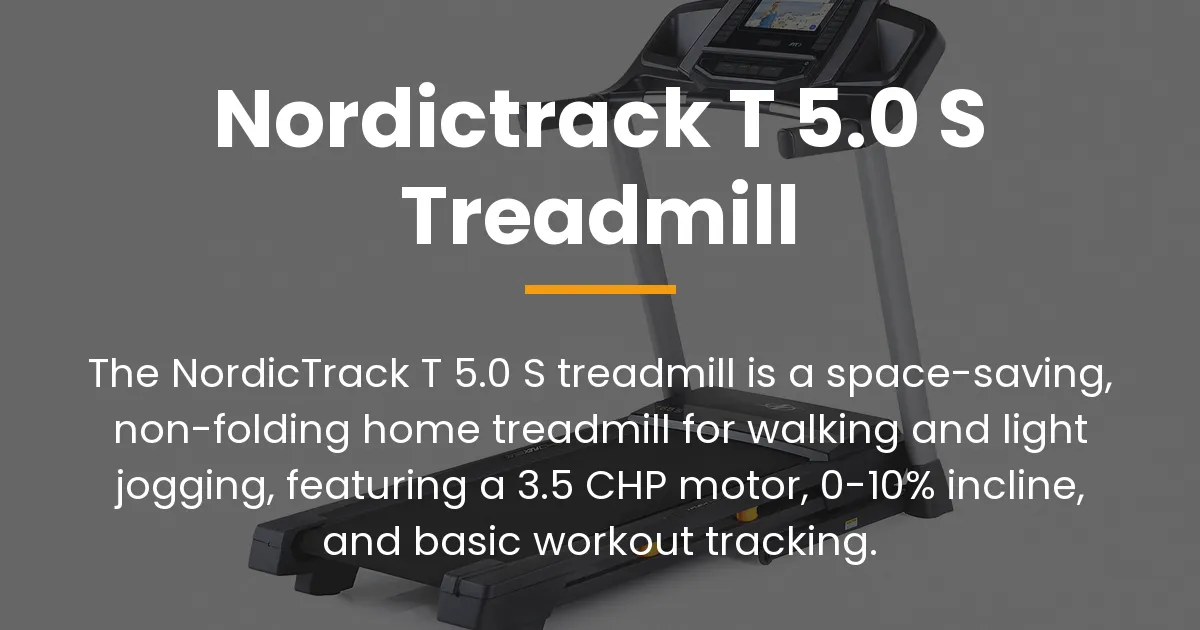
Motor horsepower is the most advertised spec, but it can be misleading for judging electricity use. Many treadmills advertise a high treadmill duty horsepower, which is a peak rating the motor can handle for short bursts. What matters more for efficiency and your electric bill is the continuous duty horsepower, which is the power the motor can sustain reliably.
A cheaper treadmill with a 3.5 treadmill duty horsepower motor might actually strain and draw more current under your regular workout load. A better-built treadmill with a 2.5 continuous duty horsepower motor could operate smoothly and efficiently at that same load, using less electricity over time. The quality of construction allows it to do more with less electrical input.
When shopping, look beyond the big horsepower number. A longer motor warranty, often 10 years or more, is a strong indicator of a robust continuous-duty motor designed for efficient, long-term use. This can lead to lower energy consumption and a longer machine life.
Calculating Your Treadmill Electricity Cost
Translating kilowatt-hours into dollars is how you answer the real question about impact on your electric bill. Follow these steps to find your personal cost.
- Estimate your average session wattage. If you mostly run, use 650 watts as a middle point. For walking, use 350 watts.
- Calculate your monthly kilowatt-hour use. Convert watts to kilowatts, multiply by your weekly workout hours, then multiply by 4.3 for the average weeks in a month.
- Find your local electricity rate. Check a recent utility bill or use online state databases. The U.S. average is about 16 cents per kilowatt-hour, but rates vary widely.
- Multiply your monthly kilowatt-hours by your local rate to get your monthly cost. Multiply by 12 for a yearly total.
To provide context, here is a comparison of monthly energy costs for common household items. These are estimates based on average usage and the national average electricity rate.
| Appliance | Estimated Monthly Cost |
|---|---|
| Home Treadmill (30 min, 5x/week) | $1.50 – $2.50 |
| Refrigerator | $5 – $10 |
| LED Television (4 hours daily) | $2 – $3 |
| Central Air Conditioner | $30 – $50+ |
This table shows that for most people, a treadmill is not a major driver of the total monthly electricity bill. Its cost is often comparable to leaving a few light bulbs on.
Energy Use for Different Treadmill Workouts
Thinking in terms of energy per workout or per mile makes electricity use much more relatable. It allows you to compare the efficiency of different routines or even compare with outdoor running.
You can calculate your energy cost per mile. First, determine the kilowatt-hours used for your session using the standard formula. Then, divide that number by the distance you covered in miles during that session.
For example, a 150-pound person running 5 miles in 50 minutes on a 650-watt treadmill uses about 0.54 kilowatt-hours. Their energy use is roughly 0.11 kilowatt-hours per mile. A 200-pound person walking 2 miles in 40 minutes on a 400-watt treadmill uses about 0.27 kilowatt-hours, which is 0.135 kilowatt-hours per mile.
This comparison reveals that while the runner used more total electricity, they were more efficient per mile covered due to the shorter time and the mechanics of running versus walking. Body weight and speed create a complex interplay that the per-mile metric helps clarify.
Reducing Your Treadmill’s Energy Consumption
You can lower your treadmill’s electricity use through smart habits and informed purchasing. For current use, regular maintenance is the most effective step. Lubricating the belt and deck every three to six months reduces friction, allowing the motor to work less and draw fewer watts.
Plug your treadmill into a power strip and turn the strip off when not in use. This eliminates phantom load, the small amount of electricity the machine uses just by being plugged in and waiting for a signal. Dimming the console display or turning off unnecessary features during workouts also saves a small amount.
When it is time to buy a new treadmill, consider the total cost of ownership. A cheaper model with a low-quality motor might have a lower sticker price but a higher long-term energy cost. A more expensive treadmill with an efficient continuous-duty motor could save you money over five or ten years.
You can create a simple 5-year cost estimate. Add the treadmill’s purchase price to the projected energy cost over five years. If a $1,200 treadmill uses $15 of electricity per year and a $900 treadmill uses $30 per year, the five-year totals are $1,275 and $1,050. The cheaper model still costs less overall in this scenario, but the gap narrows. If the more expensive model is also more durable, its longer lifespan could make it the better financial choice, proving that energy efficiency is a key spec for your wallet.
Frequently Asked Questions
Does the treadmill use electricity when plugged in but turned off?
Yes, most treadmills draw a small amount of standby power, often called phantom load. This is usually only 1 to 5 watts, but over a full year it can add up to a few dollars. Using a switched power strip completely stops this drain.
How much electricity does a walking treadmill or under-desk treadmill use?
Walking or under-desk treadmills have smaller motors designed for low speeds. Their electricity use is typically much lower, often in the range of 200 to 400 watts during operation, costing just a couple of dollars per month with regular use.
Is it more energy-efficient to run outside or on a treadmill?
From a pure energy perspective, running outside uses no electricity, so it is infinitely more efficient. However, a treadmill’s electricity cost is relatively low, and it provides a controlled environment that can be worth the minor expense for many people.
Does a manual treadmill use any electricity?
A true manual treadmill, one that is powered solely by your movement, uses no electricity. However, many “manual” treadmills sold today have a motorized incline or a small console for metrics, which would require a power connection.
How does my body weight affect the treadmill’s electricity use?
Heavier users make the motor work harder to move the belt against the increased force. This causes the motor to draw more electrical current, directly increasing wattage and total kilowatt-hour consumption during your workout.
Will using the incline setting double my electricity consumption?
It likely will not double it, but it will increase it significantly. A steep incline can increase power draw by 50% to 100% compared to a flat setting, depending on the speed and the motor’s efficiency.
Can I run my treadmill on a standard 15-amp household circuit?
Most home treadmills are designed for standard 15-amp, 120-volt circuits. A 700-watt treadmill draws about 5.8 amps, which is within the safe limit as long as nothing else powerful is on the same circuit. High-powered commercial models may require a dedicated 20-amp circuit.
How does treadmill electricity use compare to an elliptical or exercise bike?
Ellipticals and exercise bikes generally use less electricity. They often have smaller motors in the 200-400 watt range because they assist your motion rather than drive a heavy belt. Their monthly energy cost is typically lower than a treadmill’s for similar workout times.
Do LED displays and built-in fans add significantly to the power draw?
No, these features are minor consumers. A large LED display might add 10-20 watts, and a fan might add 5-15 watts. This is a small fraction of the 300-700 watts used by the main drive motor.
Should I unplug my treadmill after every use to save electricity?
You do not need to unplug it from the wall each time. Plugging it into a power strip and switching the strip off is a more convenient and equally effective way to eliminate standby power consumption between workouts.
Understanding how much electricity a treadmill uses empowers you to manage its cost effectively. The answer combines your personal habits, the engineering of your machine, and your local utility rates. By maintaining your equipment and considering energy efficiency in your next purchase, you can ensure this investment supports your health without putting an unexpected strain on your household budget.