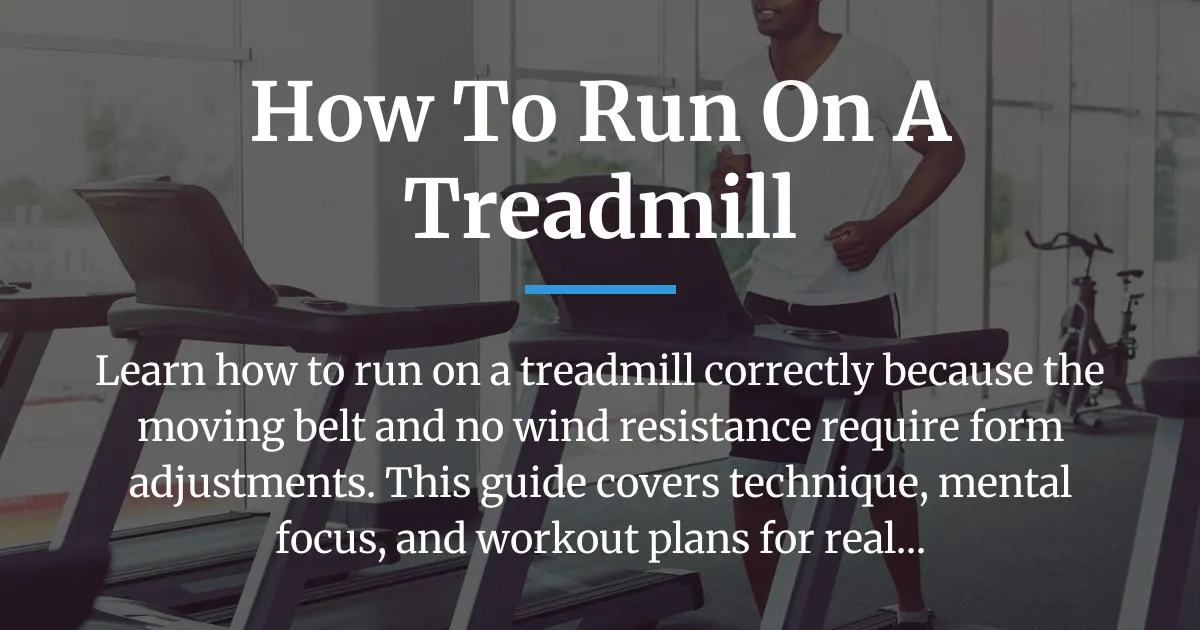
Many people see the treadmill as a boring last resort for exercise. But it is actually a powerful tool for runners. Learning how to run on a treadmill well means understanding three key changes. You must adjust your body, your mind, and your training goals. This guide will walk you through each step. You will move from basic form to advanced workouts that help you run better anywhere.
Mastering the Machine’s Environment
Running on a treadmill is not the same as running outside. The machine creates a unique setting. You need to know what makes it different before you can run well on it.
The Moving Ground Beneath You
On a treadmill, the belt moves under your feet. Outside, you push your body forward over the ground. This changes how your legs work. The moving belt pulls your foot back during each step. This can make your leg recovery feel different. Your natural stride might need a small adjustment to feel steady and smooth.
You are not propelling your body forward in the same way. The machine does some of the work for you. This is why your leg muscles might feel less engaged at first. Understanding this helps you focus on your form from the start.
The Still Air Around You
Indoors, there is no wind resistance. When you run outside, you push through the air. This takes extra effort. On a treadmill, the air is still. This means running at the same speed feels easier inside. Your body does not have to work as hard to overcome drag.
This lack of wind resistance is a big factor. It affects your perceived effort and how many calories you burn. A pace that feels hard outside might feel manageable on the treadmill. You need to account for this in your workouts.
The Unforgiving Surface
A treadmill deck is very consistent. It is flat and even for every step. Outdoor running involves gradient changes and different surfaces like hard pavement. Your body adapts to these variations naturally.
The treadmill surface does not change. This can be good for reducing impact on your joints. But it also means your muscles and tendons get the same stress repeatedly. Knowing this helps you avoid overuse injuries. You can plan your runs to mix things up.
The Foundation of Effective Treadmill Form
Good form is the base of all running. On a treadmill, it requires specific attention. Follow these steps to run correctly and safely.
Posture is Your Anchor
Stand tall on the treadmill. Keep your back upright and your shoulders relaxed. Imagine a string pulling you up from the top of your head. Engage your core muscles slightly. This posture helps you stay balanced.
Do not lean forward from the waist. Outside, you might lean into your run. On the treadmill, leaning can strain your back. Keep your body centered over your feet. Look straight ahead, not down at your feet or the console. This keeps your neck and spine in a safe line.
Your Natural Stride, Refined
Let your legs move in a natural rhythm. Aim for a mid-foot strike when your foot lands. Avoid overstriding, which means reaching your foot too far forward. The moving belt can encourage this bad habit.
Keep your steps light and quick. A higher cadence, or step count, is often helpful. Try to take many short steps instead of a few long ones. This reduces the impact on your joints. It also makes your run more efficient.
The Purpose of the Incline
Most treadmills let you set an incline. Use it. A gentle uphill better simulates outdoor running. Start with a 1% to 2% incline. This slight angle makes up for the lack of wind resistance indoors.
It also changes how your legs work. Your muscles engage more like they do outside. You can use the incline for different goals. For a simulation run, keep it low. For hill training, you can increase it in intervals. This control is a key advantage of the treadmill.
Handrails are for Safety, Not Support
Do not hold onto the handrails while running. This is a common mistake. Holding on changes your natural gait. It makes you lean back and shortens your stride. This reduces the work your legs do and lowers your calorie burn.
Use the handrails only for balance when starting or stopping. If you feel unsteady, slow down and step to the sides. Relying on the rails prevents you from building proper balance and strength.
Why Treadmill Running Feels Different
You might notice your legs feel different after a treadmill run. This is normal. The moving belt and consistent surface change muscle activation. Your hamstrings and glutes might work less compared to outdoor running. Your calves might feel more engaged.
Treadmill running is not easier. It is just different. The lack of wind resistance and gradient changes means your body adapts in new ways. Understanding this helps you adjust your expectations. It also guides how you design your workouts for balanced fitness.
Overcoming the Mental Hurdle
The treadmill can be mentally challenging. The scenery does not change. You might feel bored or distracted. Beating this is a skill you can learn. Here is a layered approach to stay engaged.
Layer 1: External Entertainment
Use external tools to pass the time. This is perfect for long runs. Listen to music or podcasts. Watch guilty pleasure shows on a tablet. Read a good book on a stand. These distractions make the minutes fly by.
They help you get through the workout without focusing on the clock. Choose entertainment that you enjoy. This makes the run something to look forward to. It turns the treadmill into your personal entertainment zone.
Layer 2: Engaging the Mind
Take your focus inward. Do a mental workout. Break your run into segments. Think about the first half and the last half separately. Every few minutes, check your form. Is your posture tall? Are your shoulders relaxed?
Visualize an outdoor route. Imagine you are running through a park or along a trail. Ask yourself, “what mile am I on?” This mental game keeps your brain active. It turns the run into a practice for focus and discipline.
Layer 3: Embracing the Focus
For shorter runs, try running with no visual distractions. Cover the treadmill display with a towel. Run by feel instead of watching the numbers. Pay attention to your heart rate or your breathing rhythm.
This practice builds internal awareness. You learn to pace yourself without external cues. It makes you a stronger runner outdoors where you do not have a machine to guide you. Embrace the staring showdown with the console as a chance to grow mentally.
From Distraction to Focused Training
Move beyond just passing the time. Use the treadmill for precise mental training. Practice holding a steady pace for twenty minutes with no entertainment. Focus only on your effort and form. This hones your concentration.
The controlled environment is perfect for this. You cannot slow down accidentally like you might outside. Use it to simulate race conditions. Practice your race fueling with a bathroom nearby. The treadmill becomes a lab for improving your running mind.
Structuring Your Run for Real-World Results
Do not just run aimlessly. Design your treadmill sessions with purpose. This ensures your indoor work translates to better outdoor performance. Here are key workout types to try.
The Simulation Run
This run mimics outdoor conditions. Set the incline to 1% or 2%. Adjust your pace so it feels like your outdoor effort. Use your perceived exertion or heart rate as a guide. This helps you maintain fitness when you cannot run outside.
It is great for consistent easy days. You get the benefits of running without the variables of weather or terrain. Over time, this keeps your body adapted to the running motion.
The Precision Interval Workout
Intervals are where the treadmill shines. You can control speed and incline exactly. Start with a warm-up. Then do 2 minute intervals at a faster pace. Between intervals, jog or walk for recovery.
You can also use higher and higher inclines. For example, after a warm-up, do intervals where you increase the incline each time. This builds strength and power. The machine lets you hit specific targets without guesswork.
The Purposeful Long Run
Long runs on the treadmill require planning. Use the entertainment layers mentioned earlier. Break the run into parts. You can split the long run inside and out if needed. Run part outdoors and part on the treadmill.
Practice aspects like fueling and hydration. Since you are indoors, you can easily access water and snacks. This makes it a safe space to test what works for your body. Your long run becomes a training session for race day.
Translating Metrics
Understand what your treadmill numbers mean for the real world. Your pace on the treadmill at a 1% incline is roughly equal to outdoor pace on flat ground. This is because the incline makes up for no wind resistance.
If you run 5 miles at 6mph on a 1% incline, that effort is similar to running 5 miles outdoors at 6mph. Use this to set goals. For example, to prepare for an outdoor 5k, do treadmill workouts at your goal pace with incline. This bridges the gap between indoor and outdoor running.
Essential Safety and Etiquette
Safety comes first. Always use the safety clip that attaches to your clothing. If you fall, it will stop the treadmill. Start by straddling the side rails. Turn on the machine and let the belt move. Then step onto the belt smoothly.
Increase speed and incline gradually. Do not make big jumps. Look forward, not down at your feet. This prevents dizziness and helps you stay balanced. Be mindful of noise if you live with other people or in an apartment. Consider an anti-vibration mat to reduce sound.
Never step on or off while the treadmill is moving at high speed. To stop, slow the belt to a walk. Step to the side rails. Then turn off the machine. These habits prevent accidents and make your run safe for everyone.
Frequently Asked Questions
What is the proper way to start and stop a treadmill?
Start by standing on the side rails. Turn on the treadmill and set a slow speed. Step onto the moving belt carefully once it is moving. To stop, reduce the speed to a walk. Step back onto the side rails. Then turn off the machine or press stop. This prevents sudden movements that could cause a fall.
How can I run on a treadmill more quietly?
Focus on a light footfall. Land softly with each step. Wear running shoes that are not worn out from outdoor use. The cushioning helps reduce noise. Place an anti-vibration mat under the treadmill. This absorbs sound and protects your floor.
Do I need special shoes for treadmill running?
No, you do not need special shoes. Your regular running shoes are fine. However, the consistent surface of the treadmill might cause different wear patterns on the soles. Check your shoes often for wear. Replace them when the cushioning breaks down to avoid injury.
How do I track a treadmill run with my watch or app?
Use the indoor run or treadmill mode on your fitness watch or app. This mode uses an accelerometer to estimate distance. For more accuracy, you may need to calibrate it after a few runs. Some treadmills sync directly with apps via Bluetooth. Check your device’s instructions for best results.
Is running on a curved or manual treadmill different?
Yes, it is very different. A curved treadmill is non-motorized. You power the belt with your feet. This engages more hamstring and glute muscles. Your form must be more active. Manual treadmills require you to set the pace entirely. They are harder and build more strength. Start slowly if you try one.
How long should I run on a treadmill as a beginner?
Start with short sessions of 10 to 20 minutes. Focus on walking and slow jogging. Gradually increase your time by a few minutes each week. Listen to your body. The goal is to build consistency without overdoing it. Mix in rest days for recovery.
Can I use the treadmill to lose weight?
Yes, treadmill running can help with weight loss. Combine steady runs with interval workouts to burn calories. Consistency is key. Aim for at least 150 minutes of moderate exercise per week. Pair your runs with a healthy diet for best results. Remember, the treadmill is a tool in a larger plan.
What should I do if I feel dizzy on the treadmill?
Stop immediately. Slow the belt and step onto the side rails. Hold onto the handrails for support. Sit down if needed. Dizziness can come from dehydration, low blood sugar, or staring at the console. Look at a fixed point in the room when you run. Drink water before and during your workout. If dizziness persists, consult a doctor.
Learning how to run on a treadmill transforms it from a dull machine into a powerful tool. Master the form adjustments for the moving belt and still air. Develop mental strategies to stay focused. Design workouts that build toward your outdoor goals. Use this guide to make every treadmill session count. Your running will improve, no matter where you choose to run.