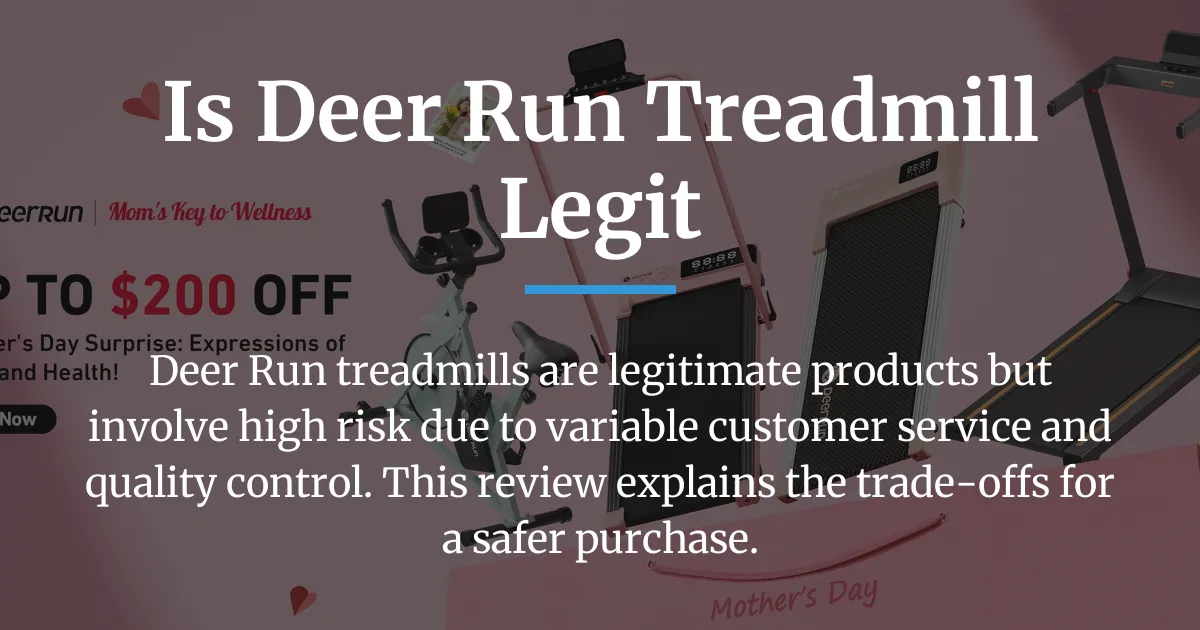
If you are asking “is Deer run treadmill legit,” you have likely seen their ads for affordable, compact walking pads. The short answer is yes, they are a real company selling real products. The complete answer is more critical. Buying from Deer Run is a trade-off. The low price and small size come with big risk and require managed expectations. This guide goes beyond polarized reviews. It gives you a clear, strategic framework for your decision.
Is Deer Run Treadmill Legit?
Deer Run treadmills exist on a spectrum of legitimacy. They are not a scam in the traditional sense. You will receive a physical treadmill that functions. However, the company’s operational model creates a high-risk environment for buyers. This means legitimacy has two parts. The product itself is real and works for basic walking. The customer experience often falls short of standard retail expectations.
Think of purchasing from Deer Run like backing a crowd-funded project. The core idea is delivered, but the journey can be rough. The company focuses on aggressive marketing and direct sales. This keeps costs low but often sacrifices quality control and support. Many customers report smooth experiences. An equal number report frustrating problems. Your outcome depends heavily on factors like model choice, timing, and your own preparedness.
The official website, deerruntreadmill.com, is the only domain you should trust for orders. Other sites might be imitations. Deer Run sells real treadmills, but the brand’s reputation is built on extreme variability. This is the central truth behind the question of legitimacy.
The Product Reality
Deer Run treadmills are functional fitness machines. They are designed as walking pads, which are compact treadmills for low-impact exercise. The products arrive in boxes and require assembly. They have a motor, a belt, a remote control, and basic controls. For their price, they perform the intended task of allowing walking in place.
The build quality is adequate for the cost. You should not expect the durability or features of a gym treadmill. The materials include plastic and metal components. The belt moves at adjustable speeds. The remote is simple, often needing to be held for operation. It is a no-frills product aimed at budget-conscious users seeking a small footprint.
The Operational Risk
Where Deer Run falters is in the post-purchase process. Customer service is the most cited issue. Reviews consistently mention horrible customer service experiences. Response times can be slow, especially during peak seasons. Email responses may take weeks. Some customers report no luck getting help at all.
Quality control is another risk. Some units arrive with missing parts or defects. The assembly process can be confusing. Models may require an Allen wrench or specific tools not included. This variability means you might get a perfect unit or one with issues. The company’s lean operation means you are often left to solve problems yourself.
Why Deer Run Reviews Are So Wildly Different
Online reviews for Deer Run treadmills paint two opposite pictures. One side praises the product as a great value. The other side warns others to stay away. This split is not random. It stems from specific, identifiable points in the customer journey. Understanding these reasons helps you gauge your own risk.
The Support Lottery
Customer service consistency is a major factor. Deer Run seems to have a small support team. During busy times, this team gets overwhelmed. The winter months are especially problematic. Many people buy fitness equipment as New Year resolutions or Christmas gifts.
Orders placed around Christmas specials can face long delays. A customer who orders in December might not get a response until mid March. This lack of communication leads to anger and negative reviews. Other customers who buy during slow periods may get quick help. This randomness creates the support lottery. Your experience depends on when you buy and how many others are seeking help.
Assembly and Design Variability
Assembly complaints are common but not universal. The issue often ties to specific models and their design choices. For example, some Deer Run models use an Allen wrench for key adjustments. The Allen wrench is a simple tool, but it can be frustrating if you are not handy. Other models use knob turning handles, which are easier to use.
The A1 Pro and Z10 Pro models are entry-level. They might have more plastic parts and simpler construction. The X20 is a higher-tier model. It should have better features. However, even the X20 has drawn complaints for using an Allen wrench for folding options. This inconsistency surprises buyers expecting premium touches.
Another design point is the two adjustable screw feet on each side. These feet help level the treadmill. If they are poorly made or hard to adjust, assembly becomes a terrible experience. Users who are prepared for DIY assembly often leave positive reviews. Those expecting a quick, tool-free setup feel cheated.
Marketing Overreach vs. Reality
Deer Run invests heavily in advertising. You see so many ads for their walking pads. These ads highlight the low price, compact size, and convenience. They set high expectations for an easy fitness solution.
The reality is more basic. The treadmill works, but it may lack any bells and whistles. The remote control is functional but simple. The speed settings are limited. The belt might be narrower than a standard treadmill. For the price, it is fair, but the ads can create an impression of a more polished product.
This gap between marketing and delivery fuels negative reviews. Customers feel misled when the product feels bare-bones. Positive reviewers often have accurate expectations. They wanted a simple walking pad and got exactly that.
Comparing Deer Run Models and Setting Expectations
Deer Run offers several treadmill models. The most discussed are the A1 Pro, Z10 Pro, and X20. Each model has different features and common issues. Your satisfaction is closely tied to which model you choose and what you expect from it.
Entry-Level Models: A1 Pro and Z10 Pro
The A1 Pro and Z10 Pro are budget-friendly walking pads. They are designed for users seeking a simple, entry-level treadmill. The A1 Pro is often marketed as a basic model. It focuses on core functionality with no extra features.
The Z10 Pro is similar but may have slight upgrades. Both models are compact and light. They are easy to store under a bed or in a closet. However, they come with trade-offs. The build uses more plastic components. The adjustment systems are minimalistic. Assembly might require an Allen wrench for key steps.
Common complaints for these models include issues with the remote control. The remote may be unresponsive or fragile. The belt alignment can be off, causing it to slip or make noise. The motor is sufficient for walking but not for running. Users report that these treadmills are loud but work as intended. Setting realistic expectations is crucial. If you want a basic walking pad for occasional use, these models can suffice. If you expect quiet operation and robust construction, you may be disappointed.
Higher-Tier Model: X20
The X20 is positioned as a premium model in the Deer Run lineup. It should have better materials and more features. The design might include a wider belt or more speed options. It often has a more stable frame.
Despite this, the X20 has its own problems. Some users note that it still uses an Allen wrench for folding adjustments. This is surprising for a top model. It shows cost-cutting even in higher-priced items. Customer service issues apply to the X20 as well. A faulty unit can be hard to repair or replace.
The X20 is good for users who want a slightly better build but are still price-sensitive. It is not a high-end treadmill. It is an upgraded version of the entry-level pads. Expect minor improvements, not a revolution in quality.
Realistic Timelines and Outcomes
When buying any Deer Run treadmill, manage your expectations for time. Shipping often takes weeks, not days. During holidays, delays can be longer. If you order a Christmas special, do not expect delivery before New Year’s.
Customer service responses are slow. Email responses can take over a week. Phone support might be unavailable. This is part of the business model. Deer Run keeps prices low by minimizing operational costs. This means you must be patient and proactive.
The product itself will likely work for walking. It may have minor quirks like noise or a stiff remote. These are common traits for budget treadmills. The key is to see Deer Run as a DIY fitness solution. You are buying a machine that requires your involvement to set up and maintain.
A Strategic Checklist for Buying a Deer Run Treadmill
If you decide to proceed after understanding the risks, use this checklist. It turns a risky purchase into a more calculated decision. Each step helps mitigate potential problems.
First, always purchase through a reputable platform. Use the official website, deerruntreadmill.com, to avoid scams. Consider using a credit card for added protection. Some online marketplaces also offer buyer protection programs. This gives you a way to dispute charges if the product is wrong or never arrives.
Second, document everything from the moment you order. Save your order confirmation and receipt. When the treadmill arrives, film the unboxing process. Record yourself opening the box and inspecting the contents. This video evidence is vital if parts are missing or damaged. It strengthens any warranty claim or return request.
Third, perform an immediate inspection before assembly. Check the belt for any tears or defects. Test the remote control to ensure it powers on. Look at all mechanical parts, like the two adjustable screw feet on each side. Verify that all tools and manuals are included. If anything is wrong, contact customer service right away with your evidence.
Fourth, prepare for self-service. Assume you will need to handle minor issues yourself. Tighten all screws during assembly. Calibrate the belt if it slips. Use online resources like video tutorials or community forums. The Deer Run official website has some guides, but user groups often have better tips. Being handy with tools will make the experience smoother.
Fifth, manage your communication expectations. When contacting customer service, be clear and polite. Include all relevant details and evidence. Follow up if you do not hear back, but allow time for responses. During busy periods like winter months, expect longer waits. If issues persist, escalate through your payment provider’s protection plan.
Conclusion
So, is Deer Run treadmill legit? As a functional product, yes. As a reliable consumer experience, it is often not. The decision to buy hinges on your personal tolerance for risk. If you value low cost and compact size above all, and you are willing to be patient and proactive, a Deer Run treadmill can work. Use the insights from this review to set realistic expectations. Document your purchase, inspect carefully, and prepare for DIY troubleshooting. Remember, buyer beware, but with a strategic approach, you can navigate the challenges and potentially find a good fitness tool for your home.
Frequently Asked Questions
Is Deer Run the same as WalkingPad or other walking pad brands?
Deer Run is a specific brand of walking pads, separate from WalkingPad or other brands. Each brand has its own models, pricing, and customer service. Deer Run is known for aggressive online ads and lower prices, while others might focus on different features or better support. It is important to research each brand individually.
Can you run on a Deer Run treadmill, or is it only for walking?
Deer Run treadmills are primarily designed for walking.