You step onto the treadmill, ready to jog, and your mind asks the same old question: what speed should I set? You see charts online saying 5 mph, but that feels too fast or too slow. You are not alone. This guide moves beyond generic numbers to help you discover your ideal speed on treadmill for jogging. We will give you a clear starting point, then show you how to adjust it for your body, your fitness, and your goals.
Benchmarks for Speed on Treadmill for Jogging
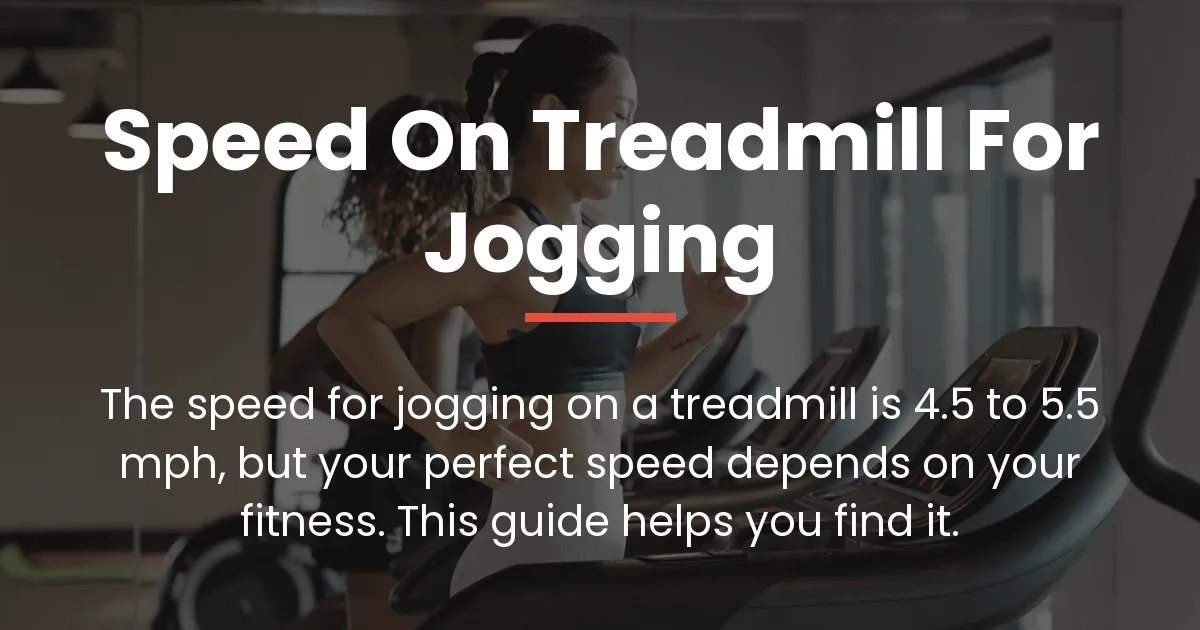
Let’s start with the basic answer everyone looks for. Jogging on a treadmill typically means a speed between 4.5 and 5.5 miles per hour, which is 7.2 to 8.8 kilometers per hour. This is a general range where most people transition from a brisk walk into a steady, gentle run. However, this is just the canvas. Your personal picture might look different.
To give you a full reference, here are the common speed zones for different activities on a motorized treadmill. This table helps you see where jogging fits in the bigger picture.
| Activity | Speed (MPH) | Speed (KPH) |
|---|---|---|
| Walking | 2.0 – 3.5 | 3.2 – 5.6 |
| Brisk Walking | 3.5 – 4.5 | 5.6 – 7.2 |
| Jogging | 4.5 – 5.5 | 7.2 – 8.8 |
| Running | 5.5+ | 8.8+ |
Remember, these numbers are a starting line, not a finish line. A former beginner might jog comfortably at 4.5 mph, while a more experienced person might find 5.5 mph easy. Your fitness level is the key that unlocks your personal speed.
Why These Speeds Are Only a Guide
The numbers on the chart come from average observations, but your body is not average. If you set the treadmill to 5.0 mph because a chart said so, you might be fine, or you might feel too much strain. The speed criteria that matters most is how you feel. A formerly obese runner might start at 4.0 mph and call that a jog, and that is perfectly correct for them. Your goal is to find the speed where you are jogging, not struggling.
Finding Your Personal Jogging Speed
Now we move from “what” to “how.” This is where you become the expert on your own body. Instead of chasing a number, you will use simple signals from your body to calibrate your perfect jogging speed. Follow these steps in your next treadmill session.
Step 1: The Simple Talk Test
The talk test is your best tool. At your true jogging speed, you should be able to speak in short sentences without gasping for breath. If you can sing, you are walking. If you can only say one word, you are running too fast. Aim for a pace where you could hold a broken conversation. This directly measures your effort level and works for everyone, regardless of fitness.
Step 2: Check Your Perceived Exertion
Back up the talk test with the Rate of Perceived Exertion, or RPE. Think of a scale from 1 to 10. One is sitting on the couch, and ten is an all-out sprint. Your jogging speed should put you at a 4 or 5. This is a moderate effort where you are working but not suffering. It feels like you could keep going for a while. This helps you gauge intensity without any fancy gear.
Step 3: The Calibration Session
Here is a practical way to find your speed. Start with a warm-up walk at 3.0 mph for 3-5 minutes. Then, increase the speed to 4.0 mph. Is that a fast walk or a slow jog? See how you feel. Now, increase by 0.2 or 0.3 mph every minute. Pay attention to the point where your walk naturally turns into a jog. Your stride will lengthen, and you will feel a light bounce. More importantly, use the talk test. The speed where you can just manage short sentences is your personal jogging speed. Write that number down. It might be 4.2, 4.8, or 5.1 mph. That is your number.
How a Treadmill Changes Your Jog
This is a crucial piece that most guides miss. Jogging on a treadmill is not the same thing as jogging outside. The machine itself changes the game. Understanding this will explain why your treadmill jog feels different and help you adjust your expectations and effort.
The Motorized Belt Does Some Work for You
On a treadmill, the belt moves under your feet. This provides a slight assist compared to propelling yourself forward on the ground. You might feel like you are putting in less effort for the same speed. This is why some people find treadmill jogging easier at first. Your leg muscles work a bit differently, with slightly less push-off force needed from your calves and hips.
No Wind Resistance Makes a Difference
When you jog outside, you push through the air. This wind resistance adds to your workload, especially as you go faster. On a treadmill, you stay in place, so there is no air moving against you. This means a 5.0 mph treadmill jog might require the same heart rate as a 4.7 mph jog outside. To match outdoor effort, some runners add a small incline of 1% to 2% to simulate wind resistance and terrain.
Your Mind Plays Tricks on You
The stationary environment can affect your perception. Without changing scenery, time can feel slower, making the jog seem harder mentally. Conversely, the steady pace of the belt can make it easier to maintain a consistent speed than outdoors. The digital display also focuses your attention on the numbers, which can make you obsessed with hitting a specific pace rather than listening to your body.
Using Speed in Your Workouts
Now that you have found your speed, let’s use it dynamically. Your jogging speed is not a fixed setting; it is a tool you can adjust for different goals, whether building endurance, improving fitness, or losing weight.
Building Endurance with Steady-State Jogging
For general fitness and endurance, use your personal conversational speed. This is the speed you found with the talk test. Aim to jog at this pace for 20 to 30 minutes continuously. The goal is duration, not speed. This builds a strong aerobic base without too much strain on your body. Remember to always start with a warm-up walk and end with a cool-down walk.
Boosting Intensity with Interval Training
To get faster or burn more calories, try intervals. After warming up, increase your speed by 0.5 to 1.0 mph above your comfortable jog for 1 to 2 minutes. You will be running, not jogging. Then, slow down to a recovery walk or slow jog for 2 to 3 minutes. Repeat this cycle 5 to 8 times. This method improves speed and cardiovascular fitness without requiring you to hold a fast pace for long.
Using Incline Instead of Speed
Increasing the incline is a fantastic way to boost intensity without increasing speed. If you want a harder workout but your joints prefer a slower pace, add a 3% to 5% incline at your jogging speed. This works your entire body differently, targeting more muscles and increasing heart rate. It is excellent for building strength and mimicking outdoor elevation changes.
When and How to Safely Increase Your Speed
Your speed should progress slowly. Do not rush. A good rule is to only consider increasing your base jogging speed after you can comfortably jog for 30 minutes at your current pace, three times a week, for at least two weeks. Then, increase by no more than 0.2 or 0.3 mph. This small jump prevents injury and allows your body to adapt. Progress is about consistency, not big leaps.
Frequently Asked Questions
Does the incline setting change my jogging speed?
Yes, incline changes the intensity of your jog, not the speed number itself. Jogging at 5.0 mph on a 5% incline is much harder than at 0% incline. For the same effort level, you might need to lower your speed when you add incline. Think of incline and speed as two dials you can adjust to control workout difficulty.
How does my weight impact the ideal jogging speed on a treadmill?
Your weight affects the effort required, not the ideal speed number. A heavier person will work harder at 5.0 mph than a lighter person. This is why perceived exertion and the talk test are so important. Focus on how you feel rather than comparing your speed to others. Your perfect speed is the one that matches your effort level, regardless of weight.
Can I train for an outdoor 5K race using only a treadmill?
Absolutely. You can effectively train for a 5K on a treadmill. To bridge the gap, remember to occasionally add a 1-2% incline to simulate outdoor wind resistance and terrain. Also, as your race approaches, try to do one jog per week outdoors if possible, to let your body adapt to the different feel of the ground.
Why do I feel unstable or bounce when I try to jog at the suggested speeds?
This often means the speed is in between a fast walk and a comfortable jog for your natural stride. Try increasing or decreasing the speed by 0.2 mph. Your body will find a speed where your gait smoothes out. Also, ensure you are not holding onto the handrails, as this can disrupt your natural balance and rhythm.
Is it better to jog for longer at a lower speed or shorter at a higher speed for weight loss?
For weight loss, total calories burned is key. Longer sessions at a moderate, conversational jogging speed are often more sustainable and effective. They burn significant calories without causing excessive hunger or fatigue. High-intensity intervals are also great but can be harder to recover from. A mix of both is ideal.
How often should I try to increase my treadmill jogging speed?
Increase your speed very gradually, about every 2-4 weeks, and only if your current pace feels easy. As mentioned earlier, only raise your speed by 0.2 or 0.3 mph after you’ve mastered longer duration at your current pace. This prevents injury and builds lasting fitness.
What should I do if the suggested “jogging” speed feels like an all-out run?
Then it is too fast for you, and that is perfectly okay. Ignore the chart and slow down. Use the talk test. Find the fastest speed where you can still talk in short sentences. That is your true jogging speed right now. Fitness is a journey, and your speed will naturally increase over time as you get stronger.
Does the type of treadmill (motorized vs. curved non-motorized) drastically change speed?
Yes, it changes everything. A curved, non-motorized treadmill requires you to propel the belt with your own effort, much like running outside. Speeds are not comparable. On these machines, you control the pace entirely with your leg power, and there is no digital speed setting. The effort on a curved treadmill is generally higher at a similar perceived pace.
How important is heart rate versus feeling when determining my speed?
Feeling, through the talk test and RPE, is more straightforward and just as effective for most joggers. Heart rate zones are useful but require a monitor and knowledge of your max heart rate. For finding your daily jogging speed, trust your perceived exertion. If you want to use heart rate, aim for 60-70% of your estimated maximum, which usually aligns with the conversational pace.
My treadmill displays pace (min/mile). What pace is equivalent to a 5 mph jog?
A speed of 5.0 miles per hour equals a pace of 12 minutes per mile. You can calculate this by dividing 60 minutes by the speed in mph. So, 60 / 5 = 12 minutes per mile. This is a handy conversion to know if your treadmill or workout plan uses pace instead of speed.
In the end, the correct speed on treadmill for jogging is a personal discovery. It is the number that lets you move with steady effort, enjoy your workout, and come back for more. Start with the benchmarks, calibrate with the talk test, understand the treadmill’s unique effects, and then use speed as a flexible tool in your fitness journey. Step on the treadmill with confidence, listen to your body, and you will find your perfect rhythm.