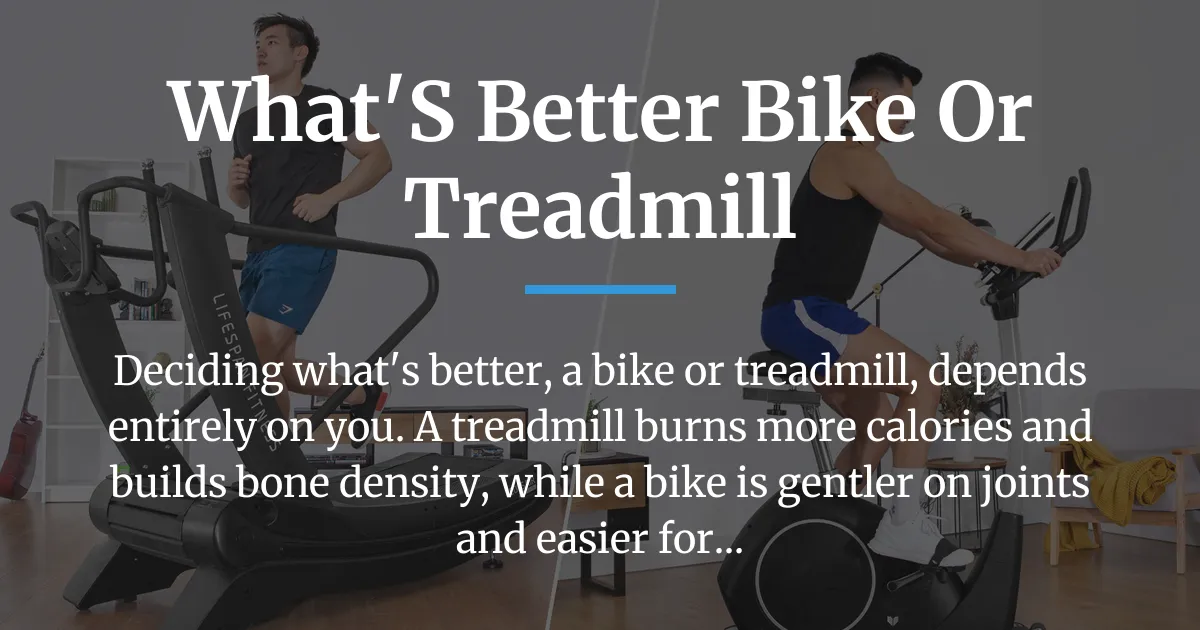
You are stuck. You want to bring serious cardio into your home but you are frozen by one big question. You see the treadmill, a machine for walking and running right in your living room. Then you see the bike, promising a powerful ride without going anywhere. Both promise fitness, weight loss, and better health. So, which one do you choose?
The real answer is not a simple champion. There is no single “better” machine for everyone. The best piece of equipment is the one that works with your body, not against it. It is the one you will actually use consistently. This guide will not just list features. It will give you a personal framework to solve this puzzle for your life, your knees, and your goals.
The Core Nature of Each Machine
To choose wisely, you must first understand the fundamental exercise each machine provides. They are not just different gadgets. They offer completely different physical experiences.
What a Treadmill Asks of Your Body
A treadmill recreates the natural act of walking and running. This is a weight-bearing exercise, meaning your legs and bones carry your full body weight with every step. Your body goes through your full walking or running gait cycle. This involves your heels striking the belt, your foot rolling forward, and your toes pushing off.
This natural movement recruits a large number of muscles. It works your entire lower body, from your calves and quads to your glutes and hamstrings. Because you are standing and moving your arms, it also engages your core for stability and can involve your upper body to some degree. The workout intensity is directly tied to your own pace. You set the speed and incline, and the machine simply follows your lead.
What an Exercise Bike Demands
An exercise bike, whether upright or recumbent, provides a seated cycling motion. This is a non-weight-bearing or low-impact activity. Your body weight is supported by the seat, which takes significant pressure off your joints. The motion is cyclical and fixed. You push and pull through a circular pedal stroke.
This movement primarily targets the major muscles of the front and back of your thighs—your quadriceps and hamstrings—along with your glutes and calves. Because you are seated and holding the handles, there is minimal core engagement unless you consciously sit tall or stand on the pedals. The resistance you set determines the challenge, forcing your muscles to work against a force, independent of your body weight.
Mapping Mechanics to Your Real-World Results
Now, let us translate those mechanical differences into actual outcomes you care about. This is where we move from textbook definitions to real-life impact on your fitness journey.
Calorie Burn and Weight Loss
If you compare the same effort level, running on a treadmill generally burns more calories than stationary cycling. Studies suggest running burns about 8 to 11 calories per minute, while vigorous cycling burns about 8 to 10.5. The treadmill’s weight-bearing nature simply requires more energy.
However, this is not the full story for fat loss. The “better” machine for weight loss is the one you can do consistently at a higher intensity. If running hurts your knees so you skip workouts, the treadmill loses. If you can sustain a brutal, sweat-drenching HIIT session on a bike three times a week, the bike wins for you. Consistency and sustainable effort always trump a slightly higher theoretical calorie burn.
Impact on Joints and Injury Risk
This is a critical dividing line. The exercise bike is the clear lower impact option. The seat supports you, making it an excellent choice for anyone with joint issues, especially in the knees, hips, or ankles. It is also ideal for rehabilitation or for heavier individuals where running might cause less pain initially.
The treadmill, as a weight-bearing exercise, places more stress on those joints. For healthy individuals, this stress helps build stronger bones and connective tissue. But for those with pre-existing conditions or a high injury risk, it can be a limiting factor. The key is your personal history. Your joints will tell you which machine is better for your long-term health.
Muscle Building and Cardiovascular Health
Both machines dramatically improve your heart health and aerobic capacity. They are fantastic for cardiovascular fitness. For pure heart health, both are a great option.
For muscle engagement, the treadmill uses a broader network of muscles through your overall gait. It can help build lean muscle in the legs and stabilize the core. An exercise bike, however, allows you to focus on raw leg strength. By increasing the resistance, you can push your quads, hamstrings, and glutes very hard in a safe, supported position. You can build significant leg muscle on a bike, especially with high-resistance, low-cadence intervals.
Bone Density and Mental Health
This is an often-ignored advantage of the treadmill. Weight-bearing exercise is a proven stimulus for increasing bone density. This is crucial for long-term bone health, especially as we age. The bike, while fantastic for joints and cardio, does not provide this same bone-strengthening signal.
For mental health, both offer the proven benefits of regular exercise. The winner here is often about personal preference. Some people find the rhythmic motion of a bike meditative. Others find the act of walking or running on a treadmill better for clearing their mind. Your boredom threshold matters greatly for mental engagement and sticking with your fitness routine.
Your Personal Decision Algorithm
With the facts laid out, it is time to plug them into your life. Ask yourself these questions in order. Your honest answers will point you to the right machine.
Question 1: What is Your Body Telling You?
This is the most important filter. Do you have chronic knee pain, a bad back, or recent surgery? If yes, start with a bike. It is the safer path to rebuilding fitness without aggravating old problems. Are your joints healthy and you want to build stronger bones? A treadmill may be the more comprehensive tool. Listen to your body first. Its advice overrules everything else.
Question 2: What is Your Primary Goal?
Be specific. Is it “lose belly fat”? If so, remember that spot reduction is a myth. Fat loss comes from a calorie deficit, which both machines can create. Choose the one you will use for longer, more intense sessions. Is it “improve my running for a 5K”? Then the choice is obvious—a treadmill. Is it “build powerful leg strength”? A spin bike with high resistance might serve you better. Align the machine’s strength with your desired finish line.
Question 3: How Will It Fit Your Actual Life?
This is about reality, not ideal workouts. Do you have limited space? A folding treadmill or a compact bike matters. Do you live in an apartment? A bike is almost always quieter than the thumping of a treadmill. Do you want to read or watch TV? It is easier to do this safely on a bike than on a running treadmill. Will you use it first thing in the morning? Consider the noise for others. Your lifestyle will determine if the machine becomes a beloved tool or a bulky clothes rack.
Question 4: What Will You Actually Enjoy?
This is the secret to long-term success. Do you dread the thought of running? Do not buy a treadmill. Do you find indoor cycling boring? Do not get a bike. The best workout is the one you do not skip. Personal preference is not a minor detail. It is the engine of your consistency. If you like variety, some bikes and treadmills come with interactive classes that might sway you.
Building a Complete Fitness Strategy
The smartest approach transcends the either-or choice. The ultimate goal is not to pick a machine, but to build a resilient, capable body. Here is how to think bigger.
The Power of Combining Both
If you have access to both, either at home or at a gym, you have a golden opportunity. Using a bike and a treadmill together is called cross-modal training. It is the secret to well-rounded fitness. Use the bike for low-impact, high-intensity leg days and active recovery. Use the treadmill for bone-building, gait-patterning, and higher calorie-burn sessions.
This combination protects your joints from the repetitive strain of doing only one thing. It challenges your muscles in different ways, preventing plateaus. It makes your fitness routine more interesting. This strategy directly answers the frustrated user who wants to stay injury-free for years.
Optimizing Your Solo Machine Choice
If you can only have one, you can still get creative to capture some benefits of the other.
If you choose a bike, you must compensate for the lack of weight-bearing and core work. Add bodyweight exercises like squats, lunges, and planks to your routine two or three times a week. Focus on high-resistance intervals on the bike to maximize leg strength and calorie burn after your workout.
If you choose a treadmill, you can make it more joint-friendly and strength-focused. Prioritize incline walking over flat running. A steep walk at 3-5 miles per hour burns fantastic calories with much less impact than jogging. It also builds serious glute and hamstring strength. Always invest in good shoes, and never ignore pain.
The Long-Term View on Your Body
Exclusive use of any single machine can lead to subtle imbalances. Only cycling might lead to overdeveloped quads and tight hip flexors if you do not stretch. Only treadmill running might neglect posterior chain strength. Be a student of your own body. Notice tightness or weakness, and supplement your cardio with targeted strength and flexibility work. Your chosen machine is the cornerstone of your fitness, but it should not be the entire house.
Frequently Asked Questions
Can a stationary bike help you lose belly fat?
Yes, a stationary bike can help you lose belly fat by creating the calorie deficit needed for overall fat loss, as consistent cycling burns calories and boosts metabolism effectively.
Is a treadmill or bike better for someone with bad knees?
An exercise bike is almost always the better choice for bad knees because it is a lower impact option that supports your body weight, placing far less stress on the knee joints.
Which machine is quieter for apartment living?
An exercise bike is significantly quieter for apartment living, as it produces a smooth, whirring sound compared to the impactful footfalls and motor noise of a treadmill.
Can I build leg muscle with an exercise bike?
Yes, you can build substantial leg muscle with an exercise bike by using high resistance settings, which force your quadriceps, hamstrings, and glutes to work hard against the pedals.
How does a treadmill affect back pain compared to a bike?
A treadmill’s impact can aggravate some types of lower back pain, while a stationary bike’s supported, seated position often provides a more comfortable and less painful workout option.
Which equipment is easier for beginners to use safely?
An exercise bike is generally easier and safer for beginners, as the risk of falling is minimal and the low-impact motion is gentle on unconditioned joints.
Is a treadmill or bike more effective for HIIT?
Both are highly effective for High-Intensity Interval Training (HIIT). The bike allows for faster resistance changes, while the treadmill allows for swift speed/incline shifts; effectiveness depends on your preferred style of intense effort.
What is the typical cost difference between a good bike and a good treadmill?
A good quality exercise bike is typically less expensive than a good quality treadmill, with solid entry-level options for each, though premium models for both can reach similar high prices.
Can I read or watch TV while using both machines effectively?
It is much easier and safer to read or watch TV on an exercise bike, as the seated position is stable. On a treadmill, it can be distracting and risky, especially while running.
Which machine has lower maintenance requirements?
An exercise bike usually has lower maintenance requirements, often needing just occasional belt tightening and cleaning, while treadmills have more moving parts like motors and belts that may need servicing.
Making Your Final Choice
So, what’s better, a bike or treadmill? The final answer lives in your personal algorithm. Weigh your body’s signals against your biggest goals. Measure the machine against the reality of your daily life. And never underestimate the power of simply enjoying your workout.
For the highest calorie burn and bone-building, lean towards a treadmill if your joints agree. For joint-friendly, consistent cardio that builds leg strength, an exercise bike is a phenomenal choice. The best home cardio machine is not the one with the highest specs. It is the one that you will walk—or pedal—toward, day after day, to build a healthier future.