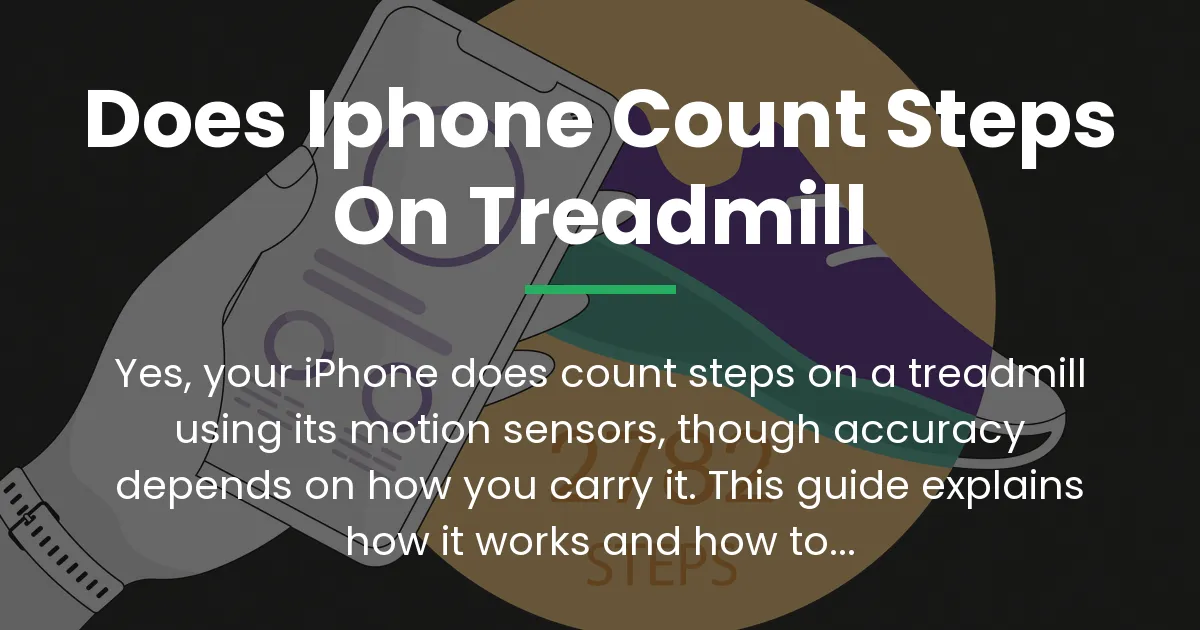
Yes, your iPhone does count steps on a treadmill. It uses its built-in motion sensors to detect the rhythm of your movement just like it would outdoors. However, getting an accurate count isn’t automatic, as the unique environment of a treadmill can confuse the phone’s technology. Understanding how it works and where to place your device is the key to turning a rough estimate into a reliable metric, and this guide will walk you through everything from the basic mechanics to managing your data in the Apple Health app.
How Your iPhone Senses Every Step
Your iPhone is constantly listening for footsteps, but not with a microphone. Deep inside it, there’s a special chip called the motion coprocessor and a sensor called an accelerometer. These components work together like a tiny, sophisticated detective for movement.
They feel the small jolts and shifts in orientation that happen when you walk or run. Each step you take creates a specific pattern of motion—a lift, a swing, and an impact. The phone’s software is trained to recognize that repeating pattern as a single step.
It is crucial to remember that this is a system based purely on motion. Unlike when you walk outside, the phone is not using GPS to figure out how far you’ve gone and then calculating steps from that distance. It is counting each individual rocking motion it detects. This fundamental fact explains both its capability and its potential for error, especially on a machine like a treadmill.
Why Treadmill Steps Are Harder to Count
Walking on a treadmill is a different experience for you and for your iPhone’s sensors. When you walk outside, your body is moving through space, your arms swing naturally, and your phone can use GPS to confirm the distance traveled. This gives the sensors multiple layers of information to work with.
On a treadmill, you are engaged in “stationary travel.” Your body is moving, but your location isn’t changing. This lack of GPS movement removes a key data point the system can use to double-check itself. All it has to go on is the back-and-forth motion from the accelerometer.
This becomes even trickier if your arm movement is limited. If you place your phone on the treadmill’s console or hold onto the handrails for balance, the sharp, rhythmic motion the sensors need to detect is dampened or completely absent. The phone might be perfectly still while your legs are moving, so it simply cannot register a step. The most common cause of a low step count is having the phone in a place where it isn’t moving with the core of your body.
The Sensor Challenge of Repetitive Motion
The repetitive nature of treadmill walking can sometimes be too uniform for the sensors. Outdoor walking involves subtle variations in stride, pace, and terrain that create a rich motion signature. The perfectly consistent motion of a treadmill belt can, in rare cases, be filtered out as background vibration rather than recognized as deliberate steps, especially if the phone is loosely placed on the machine itself.
Getting the Most Accurate Treadmill Step Count
To maximize accuracy, you need to make sure your iPhone experiences a motion pattern as close to real walking as possible. Where you put the phone is the single biggest factor you can control.
The very best method for step counting on a treadmill is to use an Apple Watch. Because it’s fastened to your wrist, it captures the natural arm swing that perfectly correlates with your stride, making it the most reliable sensor placement Apple offers.
If you are using just your iPhone, follow this hierarchy of placements for the best results. Think about keeping the phone as close to the center of your body’s motion as you can.
Optimal iPhone Placement for Treadmill Walking
Your front pants or shorts pocket is the best spot. Here, the phone moves with your hips, which have a strong, rhythmic motion with every step. This gives the accelerometer clear and consistent data to count.
A secure armband or a running belt is also a very good choice. These keep the phone firmly attached to a part of your body that is in motion, ensuring it feels every step. An armband mimics the Watch’s advantage by tying the phone to your arm swing.
Holding the phone in your hand can work if you naturally swing your arms while you walk or run. However, if you tend to look at the screen, hold the rails, or let your arm hang, the count will drop significantly. It is less reliable than a pocket or armband.
You should avoid leaving your phone on the treadmill console, in a cup holder, or in a backpack on the floor. In these static locations, the phone is isolated from your body’s movement. It might detect some vibrations, but it will miss the vast majority of your steps, leading to a huge undercount.
To Start a Workout or Not?
You do not need to start a dedicated “Indoor Walk” workout in the Fitness app just to count steps. Your iPhone’s step counter works passively all the time, no matter what you are doing. However, starting a workout does two helpful things.
First, it tells your iPhone to pay extra-close attention to your motion during that period, which can sometimes improve sensor focus. Second, and more importantly, it neatly packages all your activity data—steps, estimated calories, heart rate from a paired watch—into one timed workout segment in the Health app. This makes it much easier to review your treadmill session later compared to sifting through all-day passive data.
Navigating the Health App for Your Treadmill Data
All the steps your iPhone counts end up in the Apple Health app. This is your central dashboard for all health and fitness information. To find your treadmill steps, open the Health app and tap on the “Browse” tab at the bottom.
Next, search for “Activity” and then select “Steps.” Here you will see a chart of your daily step count. You can view data by day, week, month, or year. To see the steps from a specific treadmill session, tap on the day on the chart, and you can often see how your steps accumulated throughout the day, with spikes during your workout times.
To truly understand where your numbers are coming from, you must check the data sources. At the very bottom of the “Steps” category screen, tap on “Data Sources & Access.” This critical screen shows every device and app that writes step data to Health, such as your iPhone, your Apple Watch, or third-party apps like Fitbit or Garmin if they are connected.
The Health app is smart about merging this data to avoid double-counting. It uses a priority system to decide which source is the most accurate for a given period. Usually, if you are wearing your Apple Watch during a workout, it becomes the primary source for those minutes. Understanding this source list is the first step to solving any mystery about your step count.
When Your iPhone and Apple Watch Disagree
It is very common to notice small differences in step counts between your iPhone and Apple Watch, especially after a treadmill session. This is normal and not usually a sign that something is broken. The discrepancy happens because the two devices are in different physical locations and their sensors are capturing motion from different parts of your body.
Apple’s health data system has built-in rules to handle this. It typically gives priority to the device it deems most appropriate. For example, if your Apple Watch is unlocked and on your wrist, the system will usually use its step data during that time because a wrist-worn device is considered the superior step counter. If your Watch is off or not being worn, the system will seamlessly switch to using your iPhone’s data.
If the numbers seem wildly off, you can investigate. Go to the “Steps” section in the Health app, select “Show All Data,” and look at a specific data point. Tapping on it will often reveal which exact device (e.g., “John’s Apple Watch” or “iPhone 15 Pro”) provided that specific step count. This detective work can show you if your Watch was the main source during your workout or if it was relying on your phone in your pocket.
Small variations are inevitable. Your Watch might count a few dozen more steps because it sensed your arm movements while you were adjusting the treadmill settings with your hand, while your phone in your pocket remained still. The final number you see in the Health app’s summary is the best combined, deduplicated estimate from your entire Apple ecosystem.
Frequently Asked Questions
Does the iPhone step counter work on a treadmill if it’s in a backpack?
No, it will not work accurately if your iPhone is in a backpack on the treadmill floor or in a locker. The phone needs to move with your body’s core. In a backpack that is not firmly attached to you, it will miss almost all steps, leading to a severe undercount.
Should I start an “Indoor Walk” workout for a better step count?
Starting an “Indoor Walk” workout is not required for counting steps, as the passive tracking works constantly. However, starting a workout provides better organized data in the Health app and can help the sensors focus, making it a good practice for tracking dedicated exercise sessions.
Why does my treadmill show more distance than my iPhone Health app?
This is expected. Your treadmill measures the belt length that has passed under your feet. Your iPhone estimates distance by multiplying your counted steps by an average stride length. Since the iPhone can miss steps on the treadmill and uses a generic stride estimate, its calculated distance is almost always less than the treadmill’s mechanical measurement.
Can a Fitbit or Garmin sync steps to the iPhone Health app?
Yes, most Fitbit and Garmin devices can sync their step data to the Apple Health app if you grant permission in their respective apps. The Health app will then merge this data with steps from your Apple devices, using priority rules to avoid counting the same step twice from different sources.
Does the model of iPhone affect step counting accuracy?
All modern iPhones from the iPhone 5s onward have a motion coprocessor capable of counting steps. While newer models may have more advanced sensors, the fundamental step-counting ability and its limitations on a treadmill are the same across all these models. Placement matters far more than the model year.
How do I calibrate my iPhone for better treadmill accuracy?
Apple does not offer a manual calibration for step counting. The system learns and improves over time by comparing its motion sensor data with GPS data from outdoor walks and runs. To “calibrate” it, ensure your stride length estimates are accurate by doing several outdoor walks or runs with your iPhone in your pocket and with GPS available.
What does the Health app do with duplicate steps?
The Health app automatically merges data from your iPhone, Apple Watch, and any other connected apps. It uses sophisticated priority rules to select the best data source for any given minute, ensuring steps are not counted twice. You see one unified, deduplicated step count for the day.
Will using an armband make step counting more accurate?
Yes, using a secure armband is an excellent way to improve iPhone step count accuracy on a treadmill. It attaches the phone directly to your moving arm, providing a clear, consistent motion signal for the sensors, much like an Apple Watch does.
My phone counted steps while I was driving. Why?
This happens because the iPhone’s motion sensors can mistake vibrations for steps. The bumps and rhythmic vibrations of a car ride can sometimes mimic a walking pattern. The system is not perfect, and these false steps are a known limitation of any motion-based counter.
Do treadmill mats interfere with step counting?
No, vibration-absorbing treadmill mats are designed to dampen vibrations going into the floor, not the machine itself. They should have no noticeable effect on your iPhone’s ability to count steps, as long as the phone is on your person and moving with your body.
Conclusion
So, does the iPhone count steps on a treadmill? Absolutely, it does. It is a capable tool for tracking your general activity right from your pocket. For casual users who simply want a rough idea of their daily movement, carrying your iPhone in your pocket during a treadmill session provides a reasonable estimate.
For anyone more serious about fitness metrics, pairing your iPhone with an Apple Watch delivers vastly superior accuracy by capturing your natural arm swing. The key to success with either method is understanding the technology’s limits. By placing your device correctly and using the Health app to check your data sources, you can move from wondering about the numbers to trusting them as a reliable part of your fitness journey.