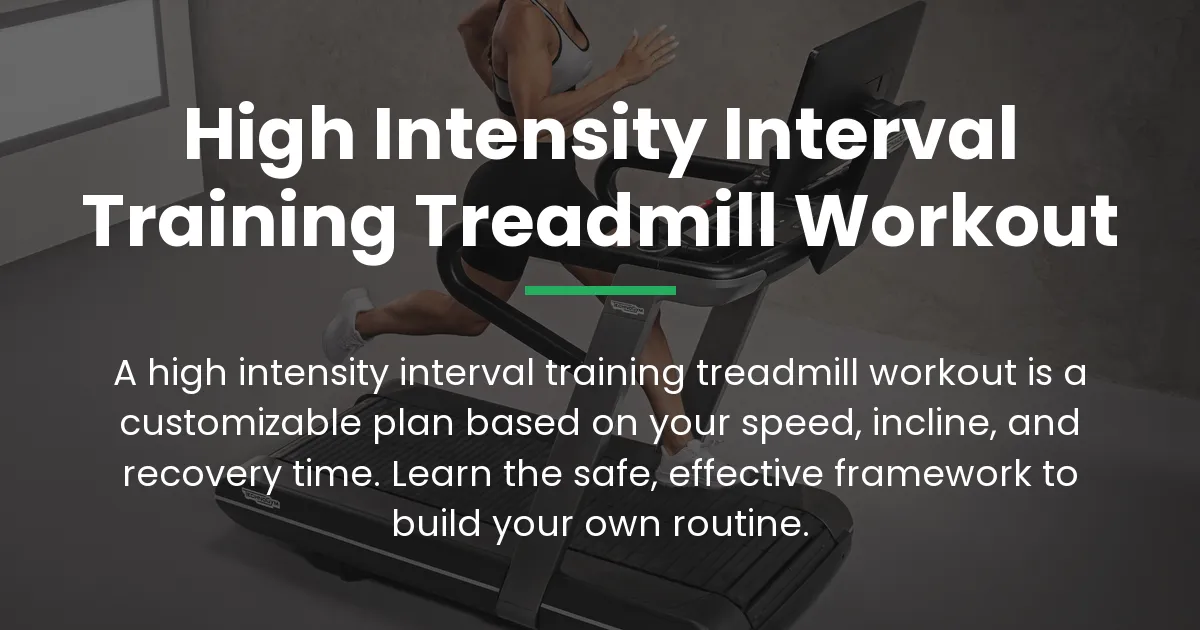
You’re ready to transform your routine with a high intensity interval training treadmill workout, and you’ve chosen the perfect tool for the job. The treadmill offers a controlled, measurable environment where you can push your limits safely. But true mastery does not come from copying a random list of speed numbers. It comes from understanding the simple variables of speed, incline, and time, which allow you to build a workout that fits your body and goals perfectly. This guide will give you that framework, moving you from following instructions to designing your own effective sessions with confidence.
The Pre-Workout Checklist
Before you even think about your first sprint, a successful session depends on proper preparation. This stage sets the foundation for safety and effectiveness, ensuring both you and the machine are ready for the challenge ahead.
Understanding Your Treadmill’s Controls
Take a moment to familiarize yourself with the console. Know where the quick-stop safety key is located and how to clip it to your clothing. Locate the speed and incline adjustment buttons, understanding how quickly they respond. This prevents fumbling during intense intervals and ensures you can stop the belt instantly if needed.
Establishing Your Baseline Pace
You need a personal benchmark. Find your “comfortable pace,” which is a steady jog or brisk walk where you can hold a conversation. Then, determine your “fast pace,” a run that feels challenging but sustainable for a minute or two. Knowing these two speeds is more valuable than any preset plan, as it allows you to scale every workout to your current fitness level.
The Non-Negotiable Dynamic Warm-Up
A proper warm-up prepares your muscles, heart, and mind. Start with five minutes of light walking or a gentle jog on a flat incline to increase blood flow. Then, incorporate dynamic movements like high knees and butt kicks right there on the treadmill deck or beside it. These movements activate the specific muscle groups you will use, reducing the risk of strain during those short bursts of intense exercise.
The Three Variables of Treadmill HIIT
Every single treadmill interval workout, no matter how complex it looks, is built from just three simple components. When you learn to manipulate these variables, you unlock the ability to create endless workouts tailored to your needs.
Measuring Intensity: Speed, Incline, and Effort
Intensity is your engine’s power. On a treadmill, you control it primarily through speed and incline. Increasing your running speed is the most direct way to raise intensity. Alternatively, adding a steep incline, like a 5-7% grade, increases resistance and engages your lower body muscles differently, often at a slightly lower speed. Your true guide, however, is your perceived effort—that feeling of working at a “maximum effort” during intervals and returning to a “relaxed pace” for recovery.
Structuring Work and Recovery Durations
The rhythm of HIIT is defined by alternating periods of hard work and rest. Work intervals are the short bursts of intense exercise, which can range from 20-second all-out sprints to one-minute sustained pushes. Recovery intervals are the following periods of light walking or jogging that allow your heart rate to come down. The length of your recovery is crucial; it should be long enough to let you repeat the work interval with good form, but not so long that you feel completely rested.
How to Combine Variables for Different Goals
Mixing these variables creates different training effects. For pure speed and power, use short work intervals (20-30 seconds) at a very fast speed with a flat incline and longer recovery. For building muscular endurance and strength, use moderate work intervals (45-60 seconds) on a challenging incline at a slower running pace. Your fitness level determines your starting point, and you can adjust any of these elements to make the workout harder or easier.
Sample Workout Frameworks
Here is how to apply the variables. Think of these not as rigid prescriptions, but as adaptable templates where you plug in your own baseline speeds and efforts.
The Speed-Focused Interval Framework
This framework prioritizes developing raw speed and cardiovascular power. After your warm-up, you will alternate between a very challenging fast speed and a complete recovery pace. A classic example is performing eight all-out 20-second sprints, each followed by one minute of light walking. Your focus is on maintaining form and pushing your pace during each short burst.
The Incline-Driven Hill Interval Framework
This build strength and power in your glutes, hamstrings, and calves while keeping joint impact lower. Set the treadmill to a 5-7% incline. Your work interval becomes a powerful, driven run or fast walk up this “hill” for 45-60 seconds. Your recovery is a flat incline walk. The speed here is less important than the consistent effort against the gradient.
The Mixed-Modality Pyramid Framework
This framework battles boredom and challenges your body in different ways. It changes the length of the work interval in a pattern. You might start with a 30-second high-intensity interval, recover, then do a 45-second interval, then a 60-second interval, and then work your way back down. You can keep the speed and incline constant, or change them at each step, making it a mentally engaging and physically demanding great workout.
Executing Your Workout with Confidence
Having a plan is one thing, but performing it safely and effectively is another. This is where knowledge turns into real-world results.
The Safe Sprint: Form and Machine Interaction
When running at a fast speed, maintain a slight forward lean from your ankles, not your waist. Keep your chest up and your gaze forward, not at your feet. Land with a mid-foot strike under your body to minimize braking force. Use the handrails only for brief balance checks—do not hold on, as it alters your posture and reduces the workout’s effectiveness. Let your arms swing naturally to drive your momentum.
Using Perceived Effort as Your True Guide
Not every day will feel the same. Some days your planned “fast speed” will feel impossible. This is where perceived effort becomes essential. Your work interval should feel like an 8 or 9 out of 10 effort. If you cannot say more than a single word, you are in the right zone. If you feel you could hold a conversation, increase the speed or incline slightly. This autoregulation ensures you get a good workout regardless of how you feel when you start.
The Structured Cool-Down and Why It Matters
Do not jump off the treadmill after your last hard interval. Gradually lower your speed to a light walking pace for at least five minutes. This helps your heart rate and blood pressure return to normal gradually, reduces dizziness, and starts the recovery process. Follow this with some gentle static stretching for your lower body, focusing on your quads, hamstrings, and calves, to improve flexibility and reduce next-day soreness.
Protecting Your Body From Injury
HIIT is demanding, and listening to your body is not a suggestion—it’s a requirement for longevity. Implementing a few key strategies will keep your joints healthy and your training consistent.
Strategies for Reducing Knee and Hip Impact
High-impact running can stress joints. To mitigate this, incorporate incline work. Running or walking on a moderate incline often reduces the “braking” force compared to flat-out sprinting. Ensure your running shoes provide adequate cushioning and support. Most importantly, pay attention to every step; if you feel a sharp or persistent pain, not just muscle fatigue, stop the workout.
The Role of the Safety Key and Emergency Stop
The safety clip is your most important piece of equipment. Always attach it to your clothing before you start. If you stumble or need to stop instantly, the clip will detach and stop the belt immediately. Know where the manual emergency stop button is on your console as a backup. This simple habit removes the fear of flying off the back of the machine and allows you to focus on your effort.
Listening to Your Body’s Warning Signals
Distinguish between the normal discomfort of hard work and signals of potential injury. Joint pain, sharp muscle pains, dizziness, or nausea are clear signs to stop. Persistent soreness that lasts for days is a sign you need more rest days between sessions. Remember, the goal is sustainable progress, not a single punishing workout.
Progressing and Personalizing Your Plan
To keep seeing results, your workout must evolve as you get fitter. A static plan leads to a plateau. Here is how to intelligently advance your training.
The Autoregulation Method for Daily Adjustment
This advanced concept puts you in full control. Instead of blindly following a set speed, you use perceived effort to guide each session. On days you feel strong, you might increase your speed or add an extra interval. On days you feel tired, you maintain your effort level even if it means using a slightly slower speed. This method respects your body’s daily fluctuations and ensures every workout is optimally challenging.
When and How to Increase the Challenge
When your current workout begins to feel manageable, it’s time for a small change. You can increase the speed or incline during your work intervals by a small amount. Alternatively, you can shorten your recovery time by 10-15 seconds, or add one more work/recovery cycle to the session. Only change one variable at a time to monitor how your body responds.
Integrating HIIT into Your Weekly Fitness Schedule
Because high intensity interval training is so demanding, balance is key. For most people, one to two treadmill HIIT sessions per week is sufficient. Pair these with lower-intensity activities like steady-state walks, strength training, or yoga on other days. This allows your body to recover and adapt, making you stronger and preventing burnout. Always schedule dedicated rest days where you focus on light activity or complete recovery.
Frequently Asked Questions
Can I do a high intensity interval training treadmill workout if I am a complete beginner to running?
Absolutely. Begin by using walking as your intensity. Your “high intensity” interval can be a fast-paced walk on an incline, and your recovery can be a slower, flat walk. Focus on the interval structure and perceived effort, not on running. Gradually, as your fitness improves, you can introduce jogging intervals.
How often should I do treadmill HIIT each week?
Start with one session per week to see how your body recovers. Most people find that one to two sessions weekly is the sweet spot for seeing results while allowing adequate recovery. Your body needs time to repair and strengthen between these intense sessions, so avoid doing them on consecutive days.
What is better for fat loss: high speed or high incline?
Both are effective as they burn a high calorie count in a short amount of time. High speed typically burns more calories during the workout itself. High incline builds more muscle, which can increase the calories you burn at rest over time. A mix of both in your weekly plan is often the best strategy.
I don’t have a heart rate monitor. How can I measure my intensity accurately?
Use the Rate of Perceived Exertion (RPE) scale or the “Talk Test.” During a work interval, you should be working at an 8 or 9 out of 10 effort. If you can say more than a couple of words, you need to increase your speed or incline. If you cannot speak at all, you might be pushing a little too hard.
What should I eat before a morning HIIT treadmill session?
If you have 30-60 minutes, a small, easily digestible carbohydrate-rich snack is ideal. A banana, a piece of toast, or a small bowl of oatmeal can provide energy without causing stomach discomfort. Most importantly, hydrate well with water before you begin.
My treadmill has a maximum speed limit. How can I make my intervals harder?
Use incline to increase the challenge. If you are already at the top speed, add a steep grade like 8-10% to your work intervals. You can also shorten your recovery time significantly, or increase the duration of your work intervals while maintaining that top speed.
Is it safe to hold onto the handrails during the high-intensity intervals?
It is not recommended. Holding on changes your running posture, reduces the core and lower body engagement, and can lead to leaning back, which is inefficient and potentially stressful on your back. Use them only for a light touch for balance when adjusting speed or incline.
How long does it take to see results from treadmill HIIT workouts?
With consistent training (1-2 times per week) alongside a balanced lifestyle, you may notice improvements in stamina and how your clothes fit within 4-6 weeks. Noticeable changes in cardiovascular fitness often come even sooner, as you find the same workouts becoming slightly easier.
Can I replace one of my steady-state runs with a HIIT treadmill workout?
Yes, this is a very effective strategy. A 20-30 minute high intensity interval training treadmill workout can provide similar or greater cardiovascular benefits in less time compared to a longer, steady run. It is an efficient way to boost fitness when you are short on time.
What are the signs that I need to take an extra rest day?
Listen to your body. Key signs include unusual fatigue before you even start, persistent muscle soreness that hasn’t faded from your last workout, irritability, trouble sleeping, or a noticeable decline in your performance. An extra day of light activity or complete rest can prevent overtraining and injury.
Conclusion
You now have more than just a few workout plans. You have the foundational knowledge to become the architect of your own fitness. By mastering the variables of speed, incline, and time, and prioritizing safety through proper warm-up, form, and recovery, you can design a limitless variety of effective sessions. Remember, the most powerful high intensity interval training treadmill workout is the one you can perform consistently and confidently, week after week. Trust the framework, listen to your body, and enjoy the results of your hard work.