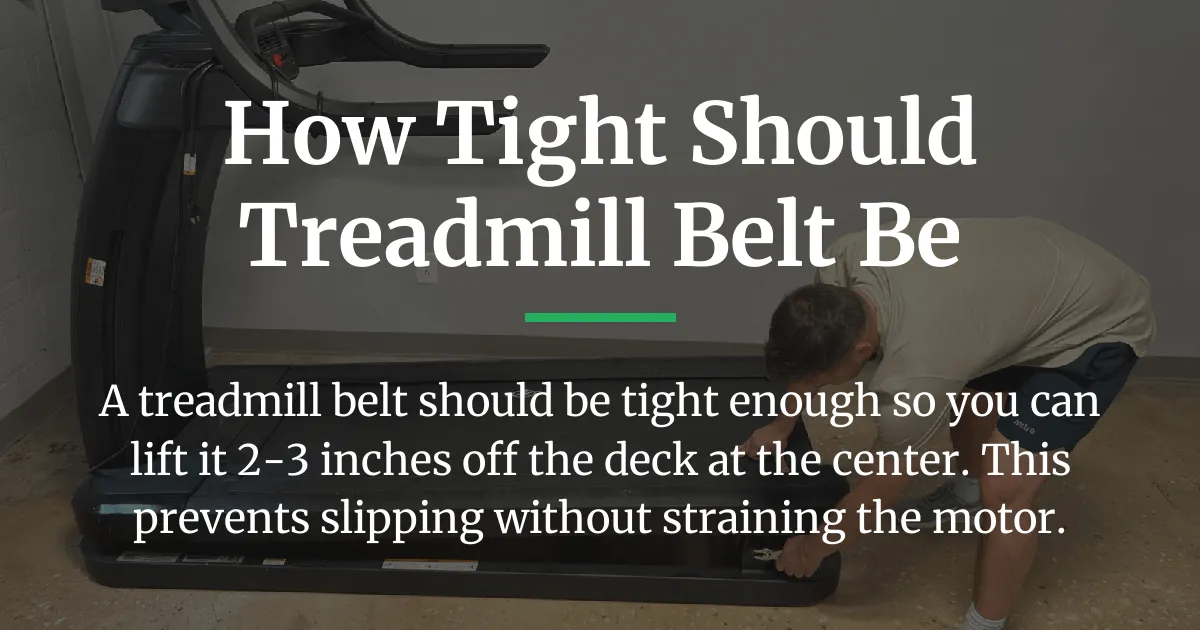
Finding the perfect treadmill belt tightness is a common puzzle for owners. You want a belt that feels solid underfoot but does not drag or strain the motor. The good news is there is a simple, universal standard to follow. For smooth and safe operation, your treadmill belt should be tight enough to lift about 2 to 3 inches off the deck at its center point. This guide will show you exactly how to measure, adjust, and master your belt’s tension.
How Tight Should a Treadmill Belt Be
The correct treadmill belt tightness is a balance between performance and machine health. You need enough tension to prevent your feet from slipping backward during a walk or run. At the same time, you need enough slack to allow the belt to move freely without putting excess strain on the motor, deck, and rollers. The proven benchmark that achieves this balance is the 2 to 3 inch lift test.
This measurement, equivalent to 5 to 7.5 centimeters, is the industry standard for most home treadmills. It applies whether you have a popular model from Sole Fitness, NordicTrack, Horizon, or other major brands. This range ensures the belt grips the deck properly for traction while still allowing the motor to work efficiently without overheating or wearing out prematurely.
Measuring Belt Tension with the Lift Test
You can check your treadmill belt tightness in less than a minute with no special tools. This test gives you a clear, physical measurement to work with.
First, ensure the treadmill is completely unplugged from the wall outlet for safety. Find the center point of the belt lengthwise, which is roughly halfway between the front roller near the console and the rear roller at the back. Place your fingers under the belt edge at this center point.
Lift upward using a moderate amount of force. You are not trying to strain or stretch the belt, just checking its natural give. Use a ruler or a tape measure to check the gap between the underside of the belt and the top of the running deck.
A correctly tensioned belt will lift easily into that 2 to 3 inch range. If it lifts much higher, like 4 or 5 inches, the belt is too loose. If it barely moves an inch or feels very stiff, the belt is too tight. This simple check is your most reliable diagnostic tool.
Signs Your Treadmill Belt is Too Loose
A belt with insufficient tension will give you clear signals during use. The most common and noticeable symptom is slippage. You will feel the belt hesitate or slip slightly under your foot, especially when your heel strikes the deck during a run.
This happens because the belt cannot maintain enough friction against the motor’s drive roller. The motor spins, but the belt does not move forward with the same force. At lower speeds, the belt might even stop completely while the motor continues to hum.
Performing the lift test on a loose belt will confirm it. The belt will feel floppy and you will be able to pull it up well beyond the 3-inch mark with little effort. Running on a consistently loose belt can cause uneven wear and damage to the belt’s underside over time.
Signs Your Treadmill Belt is Too Tight
While a loose belt is a problem, an overly tight belt can cause more serious mechanical issues. The first sign is often increased effort. The belt may feel like it is dragging, and manually moving it with your hand while the machine is off will feel difficult.
Listen to your treadmill. A belt that is too tight puts a constant heavy load on the drive motor. This can cause the motor to run louder than normal, produce a burning smell from overheating, or even trigger error codes as it struggles. You are essentially forcing the motor to work much harder than it should.
During the lift test, a too-tight belt will offer strong resistance. You might only get an inch or less of lift, or the belt may not budge at all. This excessive tension accelerates wear on the motor bearings, the belt itself, and the deck surface, leading to potentially expensive repairs.
How to Adjust Your Treadmill Belt
Once you have diagnosed that your belt needs adjustment, the process is straightforward. The key is to make small, careful changes and to always adjust both sides evenly to keep the belt centered.
You will need the proper tool, which is almost always a hex key, also called an Allen wrench. The correct size, often 4mm, 5mm, or 6mm, is usually included with your treadmill’s original toolkit. If not, a standard set of hex keys will have the size you need.
Always start by unplugging the treadmill from its power source. This is a non-negotiable safety step before performing any maintenance.
The Adjustment Process Step by Step
- Locate the Adjustment Bolts. Find the two bolts at the very back end of the treadmill, one on the left side and one on the right. These are screwed into the rear roller’s end caps. Turning these bolts moves the entire rear roller forward or backward, which changes the belt’s tension.
- Make Equal Turns. This is the golden rule. Whether you need to tighten or loosen the belt, you must turn both rear bolts exactly the same amount. A quarter turn or a half turn is a perfect small adjustment. Never turn one side multiple times without turning the other.
- Test and Repeat. After each small adjustment on each side, perform the lift test again at the center of the belt. If the belt was too loose and you tightened it, check if it now lifts into the 2-3 inch range. If not, make another set of equal quarter-turns and test again. Patience is vital.
If your belt is also tracking off to one side, the adjustment process is similar but focused on one bolt. If the belt drifts to the right, slightly tighten the right rear bolt (or loosen the left one) by an eighth of a turn. Then walk or gently run the belt to see if it centers itself, repeating as needed.
Maintaining Proper Treadmill Belt Function
Belt tightness does not work alone. It is part of a system that includes the deck and the rollers. For the best experience and longest machine life, you must consider maintenance beyond just tension.
The most critical partner to belt tension is deck lubrication. A dry deck creates immense friction, making the belt hard to move. The motor strains, and the belt can overheat and wear out quickly. Even a perfectly tensioned belt will feel like it is slipping or dragging if the deck is not properly lubricated.
Most modern treadmills require silicone-based lubricant applied between the belt and the deck. Consult your manual for the specific schedule, but a general rule is to lubricate every three months or every 130 miles of use. Regular belt checks should include a quick thought about when you last lubricated the deck.
Keep your belt clean from dust and debris. Wipe it down regularly with a damp cloth. This prevents small particles from getting between the belt and deck, which can act like sandpaper and cause damage over time. These simple maintenance tasks keep your high-performance machine in top condition.
Advanced Belt Tension Insights
Understanding a few deeper concepts will transform you from someone who follows steps into someone who truly understands their machine. This knowledge helps you solve problems faster and prevents frustration.
The Tension Lifecycle of a Treadmill Belt
A new treadmill belt is not set and forget. When brand new, the belt fibers are tight and need to break in. Many manufacturers actually set new belts a little tighter at the factory, knowing they will stretch during the first few hours of use.
This is why you might adjust your belt to the perfect 2.5 inches, only to find it feels loose again after a couple of weeks of regular use. That initial stretch is normal. Expect to check and possibly re-tension a new belt after your first 5 to 10 hours of walking or running on it. After this break-in period, the belt will stabilize and require less frequent adjustment.
Diagnosing the Real Problem
Not every issue is a tightness problem. Use this simple thinking to pinpoint the cause. Ask yourself what the main symptom is.
If the belt is slipping under your feet, your first thought should be “loose belt or dry deck.” Check the tension with the lift test. If it is within range, the issue is almost certainly a lack of lubrication on the deck.
If the motor is loud, strains, or smells hot, think “tight belt or friction.” Check if the belt is too tight. If the tension is correct, the problem could be a completely dry deck, a worn belt, or another mechanical issue.
If the belt is walking off to one side, the issue is alignment, not overall tightness. This requires the careful single-side bolt adjustments mentioned earlier to recenter the belt on the deck.
How Adjustment Actually Works
When you turn the rear adjustment bolts, you are not tightening the belt like a guitar string. You are physically moving the rear roller. Turning the bolts clockwise pulls the rear roller backward, which takes up slack in the belt path and increases tension.
Turning them counterclockwise lets the roller move forward, giving the belt more slack and decreasing tension. Because the roller is a single solid bar, turning both bolts evenly moves it straight back or forward. Turning one side more than the other tilts the roller, which is how you correct a belt that is not tracking straight.
Frequently Asked Questions
How often should I check my treadmill belt tightness?
You should perform a quick lift test every month if you use your treadmill regularly. Definitely check it if you notice any change in how it feels or sounds during a workout.
Can I over-tighten the belt and cause damage?
Yes, over-tightening is a major cause of preventable damage. It puts extreme stress on the drive motor, can warp the rollers, and causes rapid wear on the belt and deck. Always stay within the 2-3 inch guideline.
My belt is tight but still slips; what else could it be?
This is almost always a sign that your treadmill deck needs lubrication. A dry deck creates friction that the motor cannot overcome, causing a slipping feeling even with a correctly tensioned belt.
Does belt tightness affect the treadmill’s motor?
Absolutely. A belt that is too tight forces the motor to work against constant resistance, leading to overheating, louder operation, and a shorter motor lifespan. Proper tension protects your motor.
Should the belt be tighter for running versus walking?
No, the 2-3 inch standard applies universally. The correct tension provides enough grip for running and is still loose enough for efficient walking. Do not adjust it based on your workout type.
What tools do I need to adjust a treadmill belt?
You typically only need a hex key (Allen wrench). The specific size is in your manual, but a 4mm, 5mm, or 6mm wrench is common. The full adjustment process is detailed above.
How do I know if my belt needs replacement instead of adjustment?
Visible signs like cracking, fraying edges, shiny slick spots on the underside, or a consistent slipping that lubrication and tension fixes cannot resolve all indicate a belt is worn out and needs replacing.
Is the belt tightness different for curved treadmills?
The principle is the same, but always consult your curved treadmill’s specific manual. The required lift distance may differ slightly due to the unique belt and motor system on manual curved machines.
Why does my belt keep coming loose after I adjust it?
If it is a new belt, this is normal break-in stretch. If it is an older belt, it may have stretched to its limit and need replacement. Also, ensure the rear adjustment bolts are fully tightened after you find the correct tension so they do not vibrate loose.
Can I adjust the belt tension myself, or should I call a technician?
You can absolutely do this yourself. Adjusting belt tension is a standard, simple part of treadmill ownership. Following the steps in this guide will allow you to perform the task safely and effectively, saving time and money.
Keeping your treadmill belt at the correct tightness is one of the easiest and most important things you can do for your machine. Remembering the simple 2 to 3 inch rule allows you to quickly diagnose issues, prevent damage, and ensure every workout is smooth and safe. By understanding how tight your treadmill belt should be and performing regular checks, you protect your investment and guarantee reliable performance for years to come.