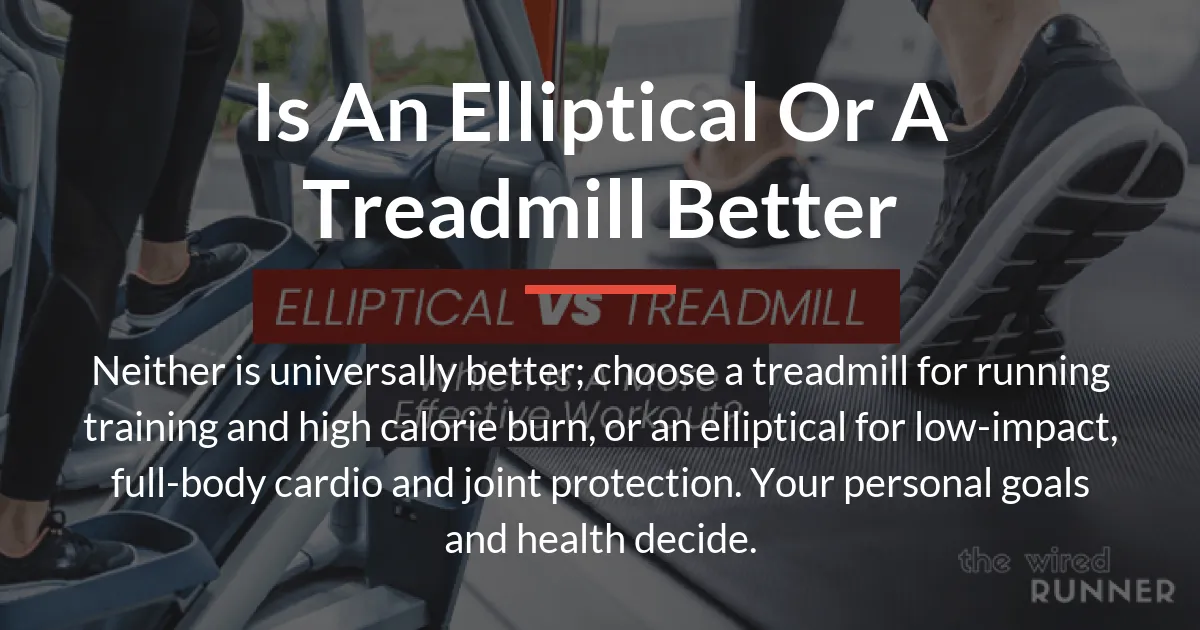
Choosing between an elliptical and a treadmill often feels like searching for a single right answer that does not exist. The truth is, the best machine for you depends entirely on your primary fitness goals, joint health, and personal preference for workout experience. For pure calorie burn and running-specific training, a treadmill often has an edge. For low-impact, full-body cardio that is gentle on joints, an elliptical is typically the better fit. Your long-term success hinges more on consistent use than the machine itself, so understanding their core differences is the first step to making your real decision.
How Each Machine Challenges Your Body
To choose wisely, you first need to know what you are really asking your body to do. An elliptical and a treadmill create fitness in fundamentally different ways, from the ground up.
The Treadmill’s Mechanism: Simulating Natural Gait
A treadmill challenges your body by replicating the act of walking, jogging, or running on solid ground. Your feet strike a moving belt, propelling you forward. This simulates your natural gait cycle, demanding balance, coordination, and propulsion from your own muscles.
The impact force when your foot lands is a key factor. This force travels up through your feet, ankles, knees, and hips. While this impact helps build bone density, it can also place too much stress on vulnerable joints, especially if your form is poor or you have existing conditions. The work is focused almost entirely on your lower body, engaging your calves, quads, hamstrings, and glutes to drive movement.
The Elliptical’s Mechanism: Guided Low-Impact Motion
An elliptical machine guides your feet through a smooth, oval-shaped path. Your feet never leave the pedals, creating a continuous motion with no jarring impact. This design makes it one of the really great forms of low-impact cardio.
Because the motion is guided, it requires less skill and balance than a treadmill. The handles, whether moving or static, allow you to engage your upper body, turning the exercise into a coordinated effort between your arms and legs. This setup mimics a cross between stair climbing, striding, and cross-country skiing, spreading the work across different muscles.
Direct Comparison of Body Impact and Muscle Recruitment
The difference in body impact is the most dramatic. The treadmill’s impact is a feature that can be a pro or a con, while the elliptical’s lack of impact is its defining characteristic. In terms of muscles, a treadmill primarily targets the posterior chain—your glutes and hamstrings—especially at an incline.
An elliptical, particularly when you use moving handles, engages both your upper and lower body simultaneously. This can lead to a higher heart rate at a lower perceived exertion. However, because the machine supports your weight and guides the motion, it typically builds less pure leg strength and power than the act of propelling yourself forward on a treadmill.
Matching the Machine to Your Primary Goal
Once you understand the mechanics, you can match each machine’s inherent strengths to what you want to achieve. This moves the conversation from abstract features to tangible results for your workout goals.
For Maximizing Calorie and Fat Burn
If your immediate goal is maximum energy expenditure, treadmills generally have a slight advantage. Running is a high-intensity activity that burns more calories per minute than the elliptical’s striding motion for most people. You can achieve a very high heart rate and metabolic demand through sprint intervals or steep incline walking.
An elliptical can certainly torch calories, especially when you ramp up the resistance and use your arms powerfully. For the same amount of perceived effort, the calorie burn may be comparable, but the ceiling for all-out intensity is often higher on a treadmill. The best equipment for weight loss is ultimately the one you will use consistently at a challenging intensity.
For Protecting Joints and Managing Injuries
This is where the elliptical shines as the clear better option for many. Its low-impact nature places minimal stress on weight-bearing joints. If you manage conditions like arthritis, are recovering from injury, or suffer from persistent shin splints, the elliptical allows you to maintain or build cardio fitness without the pounding.
A treadmill’s impact can aggravate these issues. While it can be suitable for some with careful management, the elliptical provides a much safer path to a good cardiovascular workout for those with joint concerns. It is an excellent tool for preserving long-term health by allowing consistent training.
For Building Running Speed and Leg Power
For run-specific training, nothing beats a treadmill. The principle of specificity states you get better at what you practice. To improve your running economy, speed, and leg strength for the road or trail, you need to run. A treadmill lets you precisely control speed and incline to practice intervals, hill repeats, and tempo runs.
While an elliptical builds general cardio endurance and muscular endurance, it does not replicate the specific neuromuscular patterns and ground force of running. It is a fantastic cross-training tool for runners on recovery days, but it is not a direct substitute for run training if your goal is to become a faster, stronger runner.
For Engaging the Upper and Lower Body Together
The elliptical is the winner for a true, simultaneous upper and lower body workout. By actively pushing and pulling the moving handles, you engage your chest, back, shoulders, and arms. This turns your cardio session into a more comprehensive muscular effort, which can feel more efficient.
A treadmill focuses the work on your lower body. You can carry light weights or add arm movements, but this is often awkward and can compromise your running form. If you want a cardio machine that also tones your upper body without needing a separate workout, the elliptical machine is the better fit.
For General Cardiovascular Health
Both machines are excellent tools for improving heart health. They can both elevate your heart rate into target zones that strengthen your cardiovascular system. The key for long-term health is regular, moderate-intensity activity.
From a pure heart health perspective, the consistency you can maintain is more important than the machine. The elliptical might enable more frequent workouts for those with joint pain, while a treadmill might provide more intense interval options for others. Both effectively support cardiovascular fitness when used regularly.
Choosing Between an Elliptical and a Treadmill
This is the personalization engine. Beyond goals, your own body, mind, and life circumstances are the final judges. Here is how to audit your situation.
Assess Your Joint and Injury History
Be brutally honest about your physical history. Do you have chronic knee, hip, ankle, or back pain? Do you get shin splints when you run? If the answer is yes, the elliptical’s low-impact design is likely the smarter, more sustainable choice to avoid setbacks.
If your joints are healthy and you have no history of impact-related injuries, you have the freedom to choose based on other factors. You can safely use a treadmill, focusing on good form and appropriate footwear to keep your joints happy.
Consider Your Workout Personality and Boredom Threshold
Psychological factors are critical for adherence. Which workout can you see yourself doing three times a week for the next year? Some people find the rhythmic motion of an elliptical soothing, while others find it monotonous. Many treadmills now offer extensive entertainment options and virtual courses to combat boredom.
Your personality matters. If you love the feeling of running and need varied terrain, a treadmill with incline and speed intervals might hold your interest. If you prefer to zone out with a show or podcast, the simpler, stable platform of an elliptical might be less distracting. The machine you will actually use is infinitely better than the one you avoid.
Evaluate Space and Budget Constraints
Look at your home gym space. Treadmills, especially folding ones, have a large footprint, both in length and width, and often require more clearance. Ellipticals can be more compact front-to-back, but some models have a wide stride path.
Consider noise and downstairs neighbors. Treadmills, particularly when running, generate significant impact noise and vibration. Ellipticals are generally much quieter. Budget also plays a role; you can find quality options in both categories at various price points, but direct comparisons should be made feature-for-feature.
Think About Your Long-Term Fitness Evolution
Where do you see your fitness journey going? If you aspire to run a 5K or hike mountains, a treadmill aligns with that progression. It allows you to build the specific stamina and strength for those activities.
If you view cardio as a lifelong health maintenance tool and want to preserve your joints for decades, an elliptical offers a sustainable, low-wear-and-tear path. Your choice can support your future ambitions, not just your current workout goals.
Getting Advanced Results From Your Workout
Choosing a machine is only the first step. Using it effectively is where most people plateau. This is the “how to progress” module missing from most comparisons.
Beyond Steady State: Incorporating Intervals on Both Machines
Steady-paced cardio has benefits, but for continued improvement and fat loss, interval training is key. On a treadmill, this means alternating between periods of high-speed running or steep incline walking and periods of recovery jogging or walking.
On an elliptical, intervals involve dramatically increasing the resistance and/or stride speed for a short burst, then returning to a lighter recovery pace. These intervals push your cardiovascular system harder and create a greater afterburn effect than steady low-intensity work.
Progressive Overload on an Elliptical: It’s Not Just Resistance
Progressive overload means gradually increasing demand to force adaptation. On an elliptical, most people only touch the resistance button. To truly progress, you need a multi-pronged approach.
First, track your workouts. Aim to cover more distance in the same time, or maintain distance while increasing the average resistance level each week. Second, use the ramps. Increasing incline shifts emphasis to your glutes and hamstrings. Third, focus on form: drive through your heels, engage your core, and pull hard on the handles to activate more muscle.
Progressive Overload on a Treadmill: It’s Not Just Speed
Similarly, on a treadmill, do not just run faster until you can’t. Structured progression prevents injury and plateaus. One week, focus on increasing your longest run by 5-10%. Another week, keep your run duration the same but add intervals where you spike the incline.
You can also work on decreasing your rest intervals between speed sets. Another advanced tactic is to increase the incline slightly for your entire “easy pace” run, building strength at a manageable cardiovascular intensity. This varied approach builds a more robust runner.
The Importance of Form to Prevent Injury and Boost Efficiency
Good form is non-negotiable for results. On a treadmill, avoid holding the handrails while running. This throws off your natural gait, reduces calorie burn, and can lead to poor posture. Stand tall, lean slightly from the ankles, and let your arms swing naturally.
On an elliptical, do not slouch or let your knees cave inward. Keep your chest up, core engaged, and press through your entire foot. If the machine has moving arms, use them with purpose—don’t just let them drag you along. Proper form ensures you are working the right muscles and protects your body, turning a simple cardio session into a quality movement practice.
Final Recommendation
So, is an elliptical or a treadmill better? The definitive answer is personal. There is no universal winner, only the best tool for your individual blueprint. Use this framework to decide: prioritize the elliptical if joint protection, full-body engagement, and low-impact sustainability are your top concerns. Lean towards the treadmill if running performance, maximum calorie burn potential, and high-intensity training are your primary drivers.
Your real decision should factor in your injury history, what you enjoy, and the results you seek. Whichever you choose, commit to using it with smart progression and consistent effort. That commitment, more than any machine’s specs, is what will transform your fitness and health.
Frequently Asked Questions
Is an elliptical or treadmill better for belly fat?
No single machine targets belly fat. Fat loss happens through a calorie deficit created by diet and exercise. For overall calorie burn, a treadmill may have a slight edge during high-intensity runs, but an elliptical used consistently at a challenging resistance is also highly effective. Consistency with either is more important than the choice.
Which machine is better if I have bad knees or shin splints?
An elliptical is almost always the better option for bad knees or shin splints. Its low-impact motion significantly reduces stress on joints and connective tissues, allowing you to build cardio fitness without the painful pounding that can worsen these conditions.
Can I build muscle with an elliptical or treadmill?
You can build muscular endurance and some lean muscle, especially as a beginner. An elliptical, with high resistance and full-body engagement, can help tone and strengthen leg, glute, and upper body muscles. A treadmill, particularly at steep inclines, builds leg strength. For significant muscle growth, however, strength training with weights is necessary.
Is an elliptical or treadmill better for heart health?
Both are excellent for heart health when used regularly. They effectively raise your heart rate to strengthen your cardiovascular system. The best one for your heart is the one you will use most consistently for moderate to vigorous activity over the long term.
Which machine is more effective for HIIT workouts?
Both are highly effective for HIIT. Treadmills allow for very precise speed and incline surges for running-based HIIT. Ellipticals allow for powerful resistance and speed intervals with less joint stress. The effectiveness depends on your effort level; both can deliver the intense intervals HIIT requires.