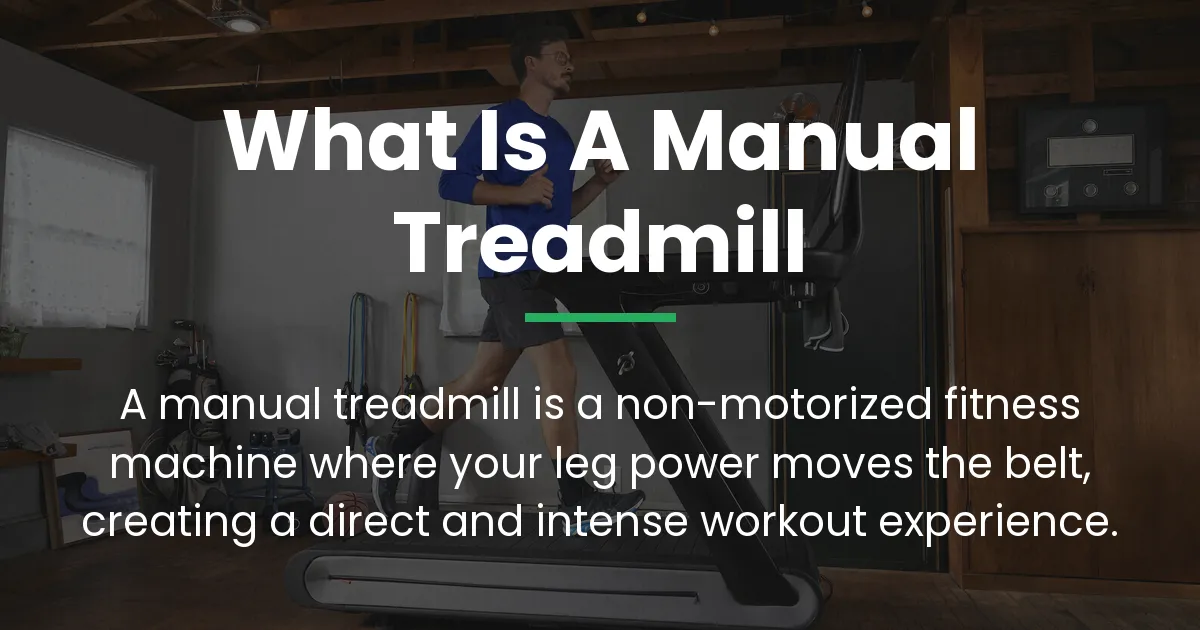
Imagine stepping onto a treadmill that has no motor, no plug, and no buttons to press. The belt under your feet stays completely still until you push it with your own legs. That is a manual treadmill. It is a simple exercise device powered entirely by your physical effort, meaning the belt only moves when and because you make it move.
This core idea creates a workout experience that feels very different from a motorized treadmill. If you are curious about this type of machine, understanding its basic definition is the perfect starting point for your research.
How a Manual Treadmill Operates
A manual treadmill works on a straightforward principle. It lacks an electric motor, so it does not need to be connected to a power outlet. The machine consists of a belt that rests on a solid deck, and this belt is connected to a flywheel or roller system that provides resistance.
When you walk or run on it, your foot strike pushes the belt backward. This action spins the rollers, and that motion is what allows you to move forward on the spot. You are essentially the engine that drives the entire system.
There are two primary designs for the belt itself, which affect how the machine feels. The first is a curved belt, which arches upward at the front. This design uses gravity and your body weight to help build and maintain momentum. The second is a flat belt, which lies completely flat like a traditional road or motorized treadmill deck, requiring pure leg drive to move.
The Physics of Your Stride
The unique feeling of a manual treadmill comes from basic physics. The first concept is inertia, which is the resistance an object has to any change in its speed or direction. When you step onto a manual treadmill, the belt is stationary. You must use significant leg force to overcome inertia and get the belt moving from a dead stop.
Once the belt is moving, you must continue to apply force to keep it going against friction and resistance. This constant demand means your muscles, especially your calves and hamstrings, are engaged continuously throughout your workout. This is why the perceived effort is higher compared to a motorized treadmill where the belt moves for you.
The belt design directly influences your biomechanics. A curved belt allows you to use gravity to your advantage, making it easier to build speed but still requiring effort to maintain it. A flat belt offers a feel closer to running on a flat road, demanding a powerful push with each step. This often encourages a mid-foot strike, which can strengthen lower-leg muscles and potentially reduce joint impact, addressing issues like shin splints.
The Experience of Using a Manual Treadmill
Using this machine is an active and engaging process. It does not allow for passive exercise because you control every aspect of the movement with your body.
Control and Connection
The most immediate benefit is the total control you have over your pace. Speed is not a number you set; it is a direct result of how hard you push with your legs. To go faster, you simply stride more powerfully. To slow down, you reduce your effort and the belt decelerates with you.
This creates a strong connection between your mind and body, making you very aware of your running form and effort level. Many runners appreciate this because it mimics the feel of outdoor running where you adjust pace naturally based on how you feel.
The Demand of Resistance
Resistance is built into the design from the first step. Because you must overcome inertia to start and then fight to maintain motion, your heart rate increases rapidly. This makes the workout intensely cardiovascular and efficient for calorie burn in a shorter amount of time.
Even at slower walking paces, the constant resistance ensures your muscles are working hard. This makes it an effective tool for people at various fitness levels, from casual users to elite athletes, all looking for a simple efficient way to elevate their physical activity.
Inherent Challenges to Recognize
The design also brings natural challenges. Starting the belt can be difficult for beginners, requiring a specific technique and body position to initiate movement smoothly. Maintaining a perfectly steady, slow pace is also tricky because the belt will slow if your effort wavers even slightly.
Additionally, manual treadmills typically lack features like programmed workouts, incline settings, or large displays. You cannot set a speed and zone out while watching a new 43 TV. This machine demands your focus, which can be a pro or a con depending on your workout style.
Matching the Machine to Your Mission
A manual treadmill is not for everyone, but it excels for specific fitness goals and user scenarios. It is important to match the machine’s characteristics to your personal mission.
If your goal is high-intensity interval training, this machine is exceptional. The instant speed response makes it perfect for sprints and interval work. You can transition from a walk to a sprint in one powerful stride, and the belt reacts immediately. This aligns perfectly with structured phased training or protocols like the Wind Protocol.
Runners seeking to improve their gait and running form will find value here. The mechanics encourage a powerful push-off and can help strengthen propulsive muscles, which is beneficial for race preparation. The forced mid-foot strike can also promote a healthier stride over time.
For the budget-conscious, manual treadmills often have a lower initial cost and no ongoing electricity costs. They are mechanically simple devices with no motor to break, meaning minimal maintenance and no monthly subscription fees for workout apps. This makes them a cost-effective tool for staying in better shape over many years.
However, if you need precise, steady pacing for health monitoring or prefer long, distracted runs, a motorized treadmill might be a better fit. The manual version requires consistent engagement, which is not ideal for everyone.
Manual Versus Motorized Treadmills
Choosing between manual and motorized treadmills depends on what you value most in your workout. Here is a clear comparison to guide your decision.
| Feature | Manual Treadmill | Motorized Treadmill |
|---|---|---|
| Power Source | Your leg drive | Electric motor (requires plug) |
| Speed Control | Directly by your effort; no buttons | Electronic controls with preset speeds |
| Workout Programs | None typically; you create your own | Various built-in programs for intervals, hills, etc. |
| Incline | No mechanical incline; simulate by effort | Often has adjustable incline (e.g., 2-3 incline or more) |
| Initial Cost | Generally lower, with a wide price range | Higher, especially for feature-rich models |
| Ongoing Costs | No electricity, minimal maintenance | Electricity costs, potential motor maintenance |
| Noise Level | Quiet, only foot strikes on the belt | Motor noise can be noticeable |
| Best For | HIIT, form training, budget users, focused workouts | Steady-state cardio, programmed variety, convenience |
In simple terms, choose a manual treadmill for intensity, direct feedback, and simplicity. Choose a motorized treadmill for convenience, programmable variety, and hands-free operation. Price differences often reflect build quality and features, with high-end manual models like the Assault runner catering to serious athletes.
Choosing and Using Your Manual Treadmill
If you decide a manual treadmill fits your needs, here are practical steps for selection and use. First, consider key purchase factors. Deck length is important for comfort; taller users or runners should look for a longer deck. Decide which belt type you prefer—curved for momentum or flat for road feel.
Check the weight capacity to ensure it supports your weight during intense workouts. Build quality affects durability and explains price differences; a sturdier frame will last longer. Also, consider your space and flooring; the machine needs a stable, flat surface to prevent wobbling during sprints.
Starting your first workout safely is crucial. Begin by standing on the side rails. Lower your body into a slight squat position. Step onto the belt with one foot and push down firmly to get the belt moving. Start with slow walks to get the feel, focusing on a full foot push-off to engage the right muscles.
For workout ideas, leverage its strengths with intervals. Try a 20-minute session: warm up with 3 minutes of walking, then alternate 1 minute of sprinting with 2 minutes of recovery jogging. Repeat this cycle. You can also create phased workouts by varying your effort in blocks, like 5 minutes moderate, 5 minutes hard, 5 minutes easy.
Maintenance is simple. Periodically check the belt for alignment and lubricate it as the manual advises. Since there is no motor, that is typically all that is needed, making it a low-maintenance piece of equipment.
Frequently Asked Questions
Can you lose weight effectively on a manual treadmill?
Yes, you can. The high resistance and constant effort lead to significant calorie burn and elevated heart rate, making it an efficient tool for weight loss when used consistently.
Are manual treadmills safer for your joints than motorized ones?
They can be safer for some people because they encourage a natural mid-foot strike, which may reduce impact on knees and shins. However, proper technique is essential to avoid strain.
How do you start and stop a manual treadmill safely?
- Stand on the side rails and lower your body into a ready position.
- Place one foot firmly on the belt and push down to start the movement.
- Step on with your other foot and begin walking or running.
- To stop, gradually slow your pace and carefully step back onto the side rails.
Do manual treadmills require any maintenance?
Very little maintenance is required. Regularly check the belt alignment and lubricate it according to the manufacturer’s instructions. There are no motors or complex electronics to service.
Can you simulate hills on a manual treadmill?
Not with a mechanical incline, but you can mimic hill training by increasing your effort, leaning your body forward, or performing high-knee drills. It is about creating extra resistance through your movement.
What is the difference between a curved and a flat manual treadmill belt?
A curved belt uses gravity and momentum for a smoother ride that can be easier to start. A flat belt requires pure leg power, offering a feel more like running on a flat road with consistent resistance.
Are manual treadmills quiet?
Yes, they are generally quiet because there is no motor. The primary sound comes from your feet on the belt, making them suitable for apartments or quiet homes.
Why are some manual treadmills so much more expensive than others?
Price differences are due to build quality, materials, brand reputation, and additional features like little LCD screens. High-end models designed for elite athletes or commercial use are built to last and cost more.
Is a manual treadmill or a stationary bike better for cardio?
Both are effective for cardio, but they offer different benefits. A manual treadmill provides weight-bearing exercise, which is good for bones and mimics running. A stationary bike is non-weight-bearing and easier on the joints, making it better for some users.
How much space do you need for a manual treadmill?
You typically need a space about 6.5 feet long by 3 feet wide. Always check the specific model’s dimensions and ensure there is extra room around it for safe access and movement.
In conclusion, a manual treadmill is a unique fitness tool that offers a direct, user-powered workout. It trades the convenience of a motor for a more connected and intense exercise experience. This makes it an excellent choice for those focused on high-intensity training, form improvement, or budget-friendly home fitness. By understanding its operation and ideal use cases, you can confidently determine if a manual treadmill is the right machine for your goals.