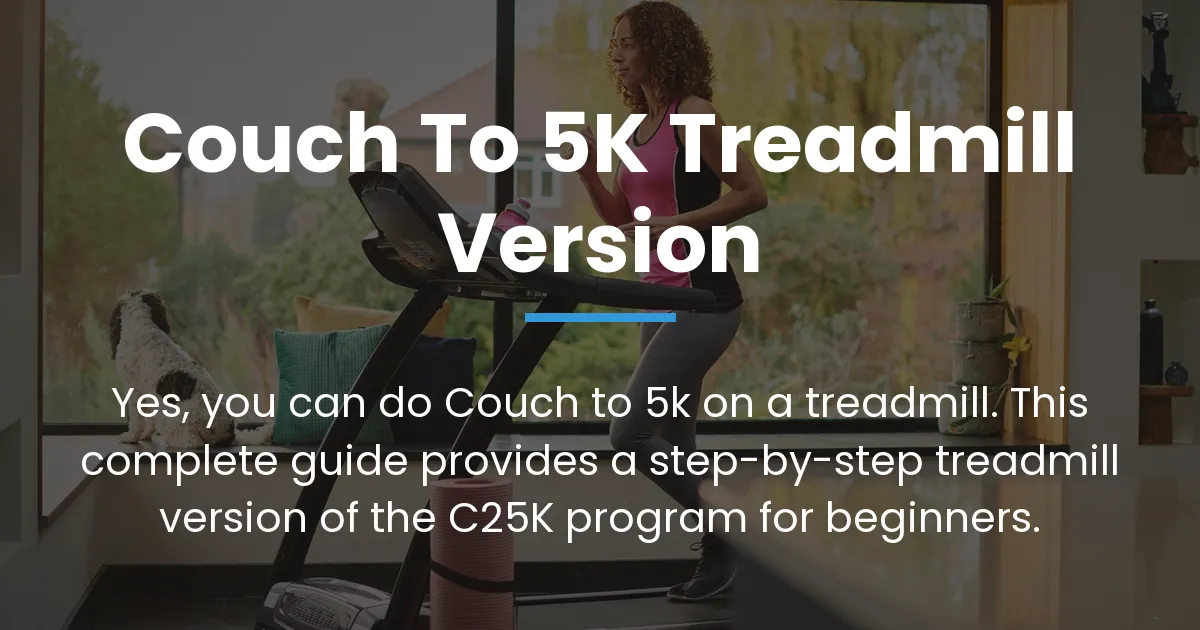
Yes, you can absolutely follow the Couch to 5k program on a treadmill. This guide to the couch to 5k treadmill version provides a clear, adapted plan for beginners who prefer indoor running. We will cover how to set up your machine, adjust for key differences, and progress smoothly to your 5k goal, making running accessible from the comfort of your home or gym.
Using a Treadmill for Your Couch to 5k Program
The core principles of Couch to 5k do not change on a treadmill. The program still builds endurance through walk-run intervals over nine weeks. Using a treadmill simply means you control the environment, which can remove barriers like weather and safety concerns for many new runners.
This controlled setting allows you to focus purely on the effort of running. You can start at any time of day without worrying about rush hour traffic or dodging cars. The consistent surface also reduces the risk of tripping over uneven ground, giving you confidence as a complete beginner.
Treadmill versus Outdoor Running
Treadmill running offers a flat, predictable surface compared to the varied terrain of outdoor running. While outdoor running involves self-propulsion and wind resistance, the treadmill belt moves for you, which subtly changes how your legs work. This can make the initial workouts feel more manageable.
Mentally, outdoor running provides changing scenery that can distract from effort. Treadmill running often requires more internal motivation to combat boredom. However, the treadmill allows for precise pace control, which is excellent for sticking exactly to the interval times prescribed in Couch to 5k.
Who Benefits Most from a Treadmill C25K
Complete beginners who feel self-conscious about running in public often find the treadmill less intimidating. If you live in an area with extreme heat, cold, or poor air quality, the indoor climate of a gym or home is a major benefit. People with busy schedules appreciate the ability to run late at night or early in the morning safely.
Those who need to monitor their progress closely benefit from the treadmill’s built-in metrics like speed and time. Individuals starting from a very low fitness level can also build confidence by controlling every variable. The treadmill version is a practical tool for building a habit without external hurdles.
Setting Up Your Treadmill for Success
Translating the Couch to 5k plan to a treadmill requires understanding a few key settings. This is not about copying exact speeds from a chart but about finding what creates the right effort level for your current fitness level. The goal is to achieve a comfortable conversational pace during walks and a sustainable slow jog during runs.
Finding Your Walking and Jogging Speeds
For the walking parts of the program, aim for a speed that lets you talk easily. A good walking speed for most beginners is between 4 to 5 kph (2.5 to 3.1 mph). This is not a power walk but a steady, deliberate pace that warms up your body without causing breathlessness.
Your jogging speed should be a slow, steady pace where you can speak in short sentences. An average jog for beginners typically falls between 6 to 8 kph (3.7 to 5 mph). Start at the very low end of this range, perhaps 6 kph, and only increase if the jog feels too easy after a few sessions. The most important thing is to match the effort, not the number on the display.
The Importance of Incline
Set your treadmill to a small incline of 1% for all walking and running intervals. This slight gradient is crucial because it simulates the wind resistance you would encounter outdoors. Running on a completely flat treadmill feels artificially easy and does not engage your posterior chain muscles like your glutes and hamstrings sufficiently.
By using a 1% incline, you better prepare your body for the reality of road running. It helps build the correct muscle strength and makes the transition off the treadmill much smoother later on. Think of it as adding just enough resistance to make your effort authentic without making the workout unnecessarily hard.
How Treadmill Running Feels Different
Biomechanically, the moving belt pulls your foot backward after it lands. This can encourage a shorter, quicker stride compared to outdoor running where you propel yourself forward. Some runners naturally increase their cadence on a treadmill, which is good, but you must be mindful not to overstride by reaching too far forward with your foot.
Psychologically, maintaining a consistent pace without visual cues from a changing landscape can be challenging. Your perceived effort might feel higher because the scenery is static, leading to boredom. This is why managing your mindset with entertainment or focusing on your form is a key part of the treadmill experience.
Couch to 5k Treadmill Version Training Plan
This is your week-by-week guide to completing the Couch to 5k program on a treadmill. Follow the intervals, use the speed and incline settings discussed, and always include warm-up and cool-down periods. The program is designed to be done three times per week with a rest day between sessions.
The Weekly Schedule Overview
The standard Couch to 5k program progresses over nine weeks. Each workout consists of alternating walking and running intervals. The table below outlines the core structure for each week, which you will execute on your treadmill at your determined speeds.
| Week | Workout Structure (Total time ~30 mins including warm-up/cool-down) |
|---|---|
| 1 | Brisk 5-min walk, then alternate 60 sec jog and 90 sec walk for 20 mins. |
| 2 | Brisk 5-min walk, then alternate 90 sec jog and 2 min walk for 20 mins. |
| 3 | Brisk 5-min walk, then two sets of: 90 sec jog, 90 sec walk, 3 min jog, 3 min walk. |
| 4 | Brisk 5-min walk, then: 3 min jog, 90 sec walk, 5 min jog, 2.5 min walk, repeat once. |
| 5 | Workout 1: 5-min jog, 3-min walk, 5-min jog, 3-min walk, 5-min jog. Workout 2: 8-min jog, 5-min walk, 8-min jog. Workout 3: 20-min jog. |
| 6 | Workout 1: 5-min jog, 3-min walk, 8-min jog, 3-min walk, 5-min jog. Workout 2: 10-min jog, 3-min walk, 10-min jog. Workout 3: 25-min jog. |
| 7 | Brisk 5-min walk, then 25 minutes of continuous jogging. |
| 8 | Brisk 5-min walk, then 28 minutes of continuous jogging. |
| 9 | Brisk 5-min walk, then 30 minutes of continuous jogging. |
The ultimate goal is to be able to jog for 30 minutes continuously, which for most beginners covers approximately 5 kilometers. Do not worry about distance initially; focus on completing the time intervals at a comfortable pace.
Executing Each Workout on the Treadmill
Begin every session with a five-minute warm-up walk at your set walking speed, with the incline at 1%. This prepares your muscles and cardiovascular system. When the interval cues you to jog, press the speed button to increase to your predetermined jogging pace. Do not jump to a much faster speed; the increase should be smooth and controlled.
During the walking recovery intervals, lower the speed back to your walking pace. Use the treadmill’s built-in timer, a watch, or the audio cues from an app like the NHS Couch to 5k app to track the intervals. Always clip the emergency stop key to your clothing so the machine stops if you stumble. Conclude with a five-minute cool-down walk at a slow pace to let your heart rate descend gradually.
Avoiding Common Treadmill Injuries
Shin pain is a frequent complaint among new treadmill runners. This often stems from overstriding or pounding your feet down heavily. To prevent this, focus on taking light, quick steps. Aim for a cadence of around 170-180 steps per minute, which encourages a mid-foot strike and reduces impact on your shins.
Do not hold onto the handrails. This bad habit alters your posture, reduces calorie burn, and can cause lower back pain. If you feel unsteady, slow down the pace instead. Ensure your running shoes are not worn out and provide adequate cushioning. Incorporate simple off-treadmill exercises like heel raises and toe taps on your rest days to strengthen lower leg muscles.
Life After Your Treadmill Couch to 5k
Completing the nine-week program is a significant achievement, but your running journey does not have to end there. This section helps you plan the next steps, whether you want to run a full 5k distance, transition outdoors, or set new fitness targets.
Completing Your First 5k
After week nine, you can jog for 30 minutes continuously. To cover a full 5k, you may need to either jog for a few more minutes or slightly increase your pace. On the treadmill, you can aim to run for 35-40 minutes at your comfortable jogging speed to ensure you hit the 5k mark, using the distance counter on the machine to track it.
Another option is to sign up for a local 5k fun run or parkrun. Your treadmill-built endurance will translate well, though the experience will feel different. Participating in an event can provide a great sense of community and accomplishment.
Transitioning from Treadmill to Road Running
If you wish to start running outside, begin gradually. Your first outdoor run should be short, perhaps only 10-15 minutes. Do not be discouraged if it feels harder; this is normal due to wind, terrain, and the absence of the moving belt. Your pace will likely be slower outdoors, and that is perfectly fine.
A sensible transition plan is to replace one treadmill run per week with an outdoor run for two to three weeks. For example, keep two sessions on the treadmill and do one shorter run outside. This allows your body to adapt to the new demands without overwhelming you. Expect to feel new muscle soreness, especially in your calves and ankles, as they stabilize on uneven ground.
What to Do Next to Keep Improving
To maintain and build your fitness, set a new goal. You could work on improving your 5k time on the treadmill by incorporating one weekly session with slightly faster intervals. Another path is to increase your distance slowly, aiming for a 10k program next.
Cross-training with activities like swimming, cycling, or strength training will improve your overall athleticism and prevent running burnout. Joining online forums or local running groups can provide motivation and advice. The key is to find an activity you enjoy so that exercise remains a sustainable part of your life.
Frequently Asked Questions
Do I need special running shoes for the treadmill?
No, you do not need special shoes, but you should wear proper running shoes that fit well and offer support. Shoes designed for road running are perfectly fine for treadmill use.
Can I use the NHS Couch to 5k app on a treadmill?
Yes, the NHS Couch to 5k app works perfectly on a treadmill. Just follow the audio cues for when to walk and run, adjusting the treadmill speed manually at those times.
Is it okay to hold onto the treadmill rails?
It is best not to hold onto the rails. Doing so changes your running form, reduces the workout’s effectiveness, and can lead to poor posture and injury. If you need balance, lightly touch the rails only until you feel steady.
How do I track my distance if the treadmill uses miles?
If your treadmill displays miles, remember that 5 kilometers equals about 3.1 miles. You can use the treadmill’s distance counter to track your progress toward that goal over the weeks.
What should I do if I miss a workout?
If you miss a workout, simply repeat the last session you completed successfully. Do not skip ahead. Consistency over the long term is more important than sticking rigidly to the calendar.
Can I listen to music or watch TV while doing the program?
Yes, listening to music or watching TV can help with boredom. However, keep the volume at a safe level so you can still hear your breathing and remain aware of your body’s signals.
What type of treadmill is best for a beginner?
Any treadmill with adjustable speed and a 1% incline setting is suitable. A machine with a cushioned deck is gentler on your joints. You do not need expensive features; basic functionality is enough for Couch to 5k.
Is a treadmill Couch to 5k easier or harder than the outdoor version?
Physically, it can feel slightly easier due to the controlled environment and lack of wind, but setting the incline to 1% makes it comparable. Mentally, many find it harder due to the monotony, which is why managing boredom is part of the strategy.
What should I wear for treadmill running?
Wear lightweight, moisture-wicking clothing similar to what you would wear for outdoor running. Avoid baggy clothes that could get caught. Comfortable running shoes and a supportive sports bra for women are essential.
How do I stay motivated running indoors?
Set small, weekly goals, create a motivating playlist, vary your treadmill incline slightly on different days, and track your progress in a journal. Celebrating each completed workout can also boost your motivation.
In summary, the couch to 5k treadmill version is an effective and accessible way to start running. By understanding the setup, following the adapted plan, and focusing on proper form, you can build a strong running foundation. Listen to your body, use the incline, and celebrate each step forward. Whether you continue on the treadmill or take your runs outside, you have launched a lasting healthy habit.