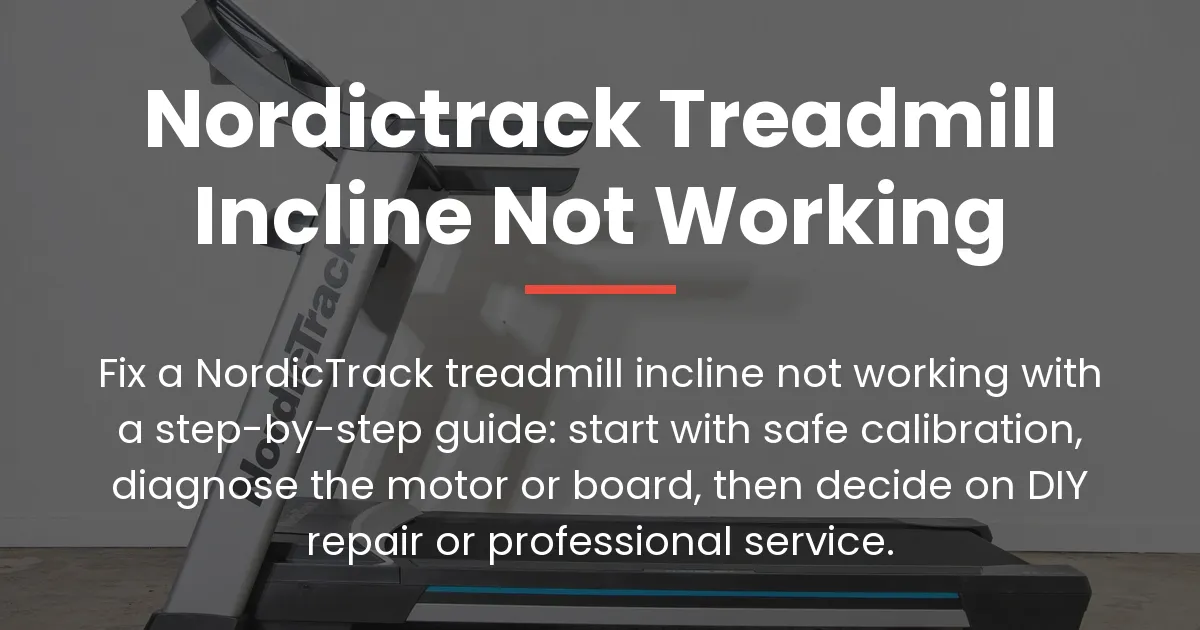
It’s incredibly frustrating when your NordicTrack treadmill incline stops working. You’re ready for a workout, but the machine won’t budge past zero or gets stuck at a steep angle. Before you panic or consider it a lost cause, know that most incline failures follow a logical pattern and can often be fixed. This guide provides a clear, safe path to diagnose and resolve the issue, moving from simple resets to component-level repairs, and helps you decide the best course of action.
Safety and Your First Steps
Before touching any tools or looking inside your treadmill, your absolute first step is safety. This is the most important and most ignored part of the process.
Always unplug the treadmill from the wall outlet. Do not just turn it off with the power switch. Physically removing the plug ensures there is no electrical current running to the motor or control board, preventing shock or accidental activation while you are working.
Next, find your treadmill’s model number. It is usually on a sticker on the frame near the front or side, or sometimes under the console hood. This number is crucial for looking up warranty status, ordering correct replacement parts, and finding model-specific guides.
Check if your machine is still under warranty. If it is, attempting a complex DIY repair might void that coverage. Contact NordicTrack support first. Be honest with yourself about your skill level. Checking for a loose wire is simple, but soldering a new connector or replacing a motor requires more comfort with tools and mechanics.
Quick Fixes to Try Immediately
Often, the problem is not a broken part but a simple electronic glitch or miscommunication. These steps are safe, require no tools, and can solve the issue in minutes.
Calibrate the Incline System
Calibration is the most common fix for an unresponsive or inaccurate incline. It resets the machine’s understanding of what “level” and “maximum” incline are. The exact button sequence can vary slightly by model, but the general process is the same.
With the safety key inserted and the treadmill plugged in, start by holding the STOP button and both incline adjustment buttons (up and down) for about 10 seconds. The console may beep or show a calibration message.
Follow any on-screen prompts. This often involves letting the incline rise to its maximum height and then lower completely. Do not interrupt this process. Once finished, test the incline with a manual button press.
Power Cycle the Entire Machine
A full power cycle can clear temporary software errors. Unplug the treadmill from the wall. Then, remove the safety key from the console. Wait for at least two full minutes.
This waiting period allows any residual power in the system’s capacitors to drain completely. After waiting, plug the machine back in, insert the safety key, and test the incline function. It’s a simple reset that works more often than you’d think.
Check Physical Connections
Inspect the safety key and its port. Make sure the key is fully inserted and that the metal contacts are clean and not corroded. The incline function will not work without a recognized safety key.
Gently push on all wire connectors you can see without taking the machine apart, especially the ones leading from the console down into the motor hood. A connection might have vibrated loose over time.
Diagnosing the Source of the Failure
If the quick fixes didn’t work, your **NordicTrack treadmill incline not working** problem is likely a hardware issue. The key now is to listen and observe. Your treadmill’s specific symptoms point directly to the failed component.
Match what you see and hear to the descriptions below to narrow down the culprit before you open any panels or order parts.
Understanding the Symptoms
Is there no sound at all when you press the incline buttons? A complete lack of noise, not even a hum or click from the base, usually points to an electrical failure. The power isn’t reaching the incline motor.
This could be due to a broken wire in the harness, a failed motor control board that isn’t sending the signal, or, less commonly, a completely dead incline motor. The control board is a frequent suspect when there is zero response.
Do you hear a humming, buzzing, or clicking sound? A motor that hums but doesn’t move is trying to work but can’t. This often means the motor itself is getting power but is mechanically seized or jammed.
Alternatively, a broken gear inside the motor assembly can cause clicking or grinding noises as the motor spins uselessly. This sound means the motor is likely the primary issue.
Does the incline move erratically or stop at a certain point? If the incline works sometimes but not others, or only goes up to 5% before stopping, you may have a faulty sensor or a mechanical obstruction.
Something could be physically blocking the lift mechanism’s path, like a forgotten object that rolled underneath. Worn or dirty sensors that track the incline position can also cause this confusing behavior.
Visual and Manual Inspection
Now, with the machine unplugged, you can look closer. Carefully tip the treadmill deck up or look underneath to check the incline mechanism’s path. Look for any obvious blockage, like a toy, piece of clothing, or a buildup of dust and debris.
Manually try to move the incline mechanism by hand, if possible. On many models, you can gently lift the front of the deck. It should move with some resistance from the drive screw. If it is completely stuck, something is jammed or the motor is seized.
Locate the incline motor. It’s typically housed in a covered compartment at the front of the treadmill base, near the floor. Look for any signs of physical damage, burning, or a melted plastic smell coming from the motor housing.
Checking Electrical Connections
This step requires more care. After unplugging the machine, you can open the motor compartment cover, usually held by a few Phillips-head screws.
Inside, you’ll see the incline motor and a tangle of wires. Do not cut or remove anything yet. Simply look for any wires that have come disconnected from their plastic plugs.
Trace the wires from the incline motor back to where they plug into the main motor control board. Firmly press on each connection to ensure it is seated properly. Look for any wires that are pinched, frayed, or have exposed copper.
The Main Components That Fail
Understanding what each part does makes diagnosis much clearer. There are three main players in the incline system.
The incline motor is the workhorse. It’s a small electric motor that, when powered, turns a long threaded rod (a lead screw). This turning motion pushes or pulls the front of the treadmill deck up and down.
The motor control board is the brain. It takes the command from your button press on the console and sends the correct amount of power to the incline motor. If this board burns out or fails, the signal never gets sent.
The wire harness is the nervous system. It is the bundle of wires that carries power and signals between the console, the control board, and the incline motor. A single broken wire inside this bundle can stop the entire function.
Choosing Your Repair Path
Once you have a likely diagnosis, you face a practical decision. Should you fix it yourself, hire someone, or consider a new machine? This choice depends on cost, your skill, and the treadmill’s value.
Doing the Repair Yourself
Replacing the incline motor is a common DIY task. If you’ve diagnosed a seized motor or one with broken gears, you can order a direct replacement. Use your model number to find the exact part from NordicTrack or a reputable fitness parts supplier.
The job typically involves unplugging a few wire connectors, removing several bolts that hold the motor in place, swapping the unit, and bolting it back. It requires basic wrenches and socket sets. A motor itself often costs between $100 and $200.
Replacing the motor control board is more complex and expensive. It involves more wiring and is usually a more delicate component. If you are not comfortable with a multi-wire connection job, this is where you might call a professional. The board can cost $150 to $300.
Hiring a Professional Technician
If the diagnosis points to the control board or you are unsure, hiring a pro is wise. Look for a certified exercise equipment repair specialist, not just a general handyman.
They will have the tools and knowledge for a precise diagnosis and can often get parts at a better rate. Expect a service call fee plus the cost of the part and labor. A single repair like this can range from $250 to $500 depending on the part and travel time.
The Repair Economics Guide
This is the critical step most guides miss. Before spending money, ask yourself these questions. How old is my NordicTrack treadmill? If it’s over 8-10 years old and has other signs of wear, investing in a major repair may not be worth it compared to the cost of a new machine.
What is the cost of the repair versus replacement? If a $150 motor fixes a $1,500 treadmill that is otherwise in great shape, it’s a good investment. If you need a $300 control board for a 12-year-old model, it might be time to start shopping.
Consider your own time and stress. A DIY repair can save money but costs your time and carries the risk of error. A professional repair costs more but is fast and guaranteed. Weigh what is more valuable to you right now.
Conclusion
Fixing a **NordicTrack treadmill incline not working** is a systematic process, not a guessing game. Start with the safe, simple resets like calibration and power cycling. If that fails, use the symptoms—no sound, grinding noise, or erratic movement—to diagnose the likely failed part, whether it’s the motor, control board, or a loose wire.
Finally, make a smart decision based on the repair cost, the age of your equipment, and your own technical comfort. By following this logical path, you can move from frustration to a clear and effective resolution, getting you back on track with your fitness goals.
Frequently Asked Questions
Does calibrating the incline erase my workout data?
No, calibrating the incline does not erase your personal workout history or iFit data. It only resets the mechanical sensors that determine the incline angle.
Where is the incline motor located?
The incline motor is almost always located in a covered compartment at the very front of the treadmill’s base, near where it touches the floor. You usually need to remove a plastic cover held by screws to see it.
Can a power surge cause the incline to stop working?
Yes, a power surge can damage the sensitive motor control board, which controls the incline function. Using a high-quality surge protector for your treadmill is always recommended.
What does a loud grinding noise mean?
A loud grinding or clicking noise from the base when you try to adjust the incline almost always indicates a mechanical failure inside the incline motor itself, such as broken plastic gears. The motor is likely the part that needs replacement.
Is it safe to use the treadmill if the incline is stuck?
If the incline is completely stuck at 0%, using the treadmill for walking or running is generally safe, though you miss out on workouts. If it’s stuck at a high angle, it can put extra strain on the motor and belt and is not recommended for long use.
Can an iFit update cause incline problems?
While rare, a software glitch from an iFit update could potentially interfere with console commands. This is why a full power cycle is a key troubleshooting step, as it can clear such software errors.
How long does an incline motor typically last?
With regular use, a NordicTrack incline motor can last 5 to 10 years. Its lifespan depends heavily on how often you use the incline feature and the weight it regularly supports.
How do I find my model number for parts?
Look for a white or silver sticker on the frame of the treadmill. Check near the front by the floor, on the side rails, or underneath the console hood. The model number will be clearly labeled, often starting with letters like “NTEL” or “CST.”
Will aftermarket parts from Amazon void my warranty?
If your treadmill is still under its original manufacturer’s warranty, using non-OEM (aftermarket) parts will almost certainly void that warranty for any future repairs. Always check your warranty terms first.
Should I get an extended warranty after a repair?
It depends on the cost and the treadmill’s age. For a newer, high-end model you just repaired, an extended warranty might offer peace of mind. For an older machine, the cost of the warranty may not be worth it.