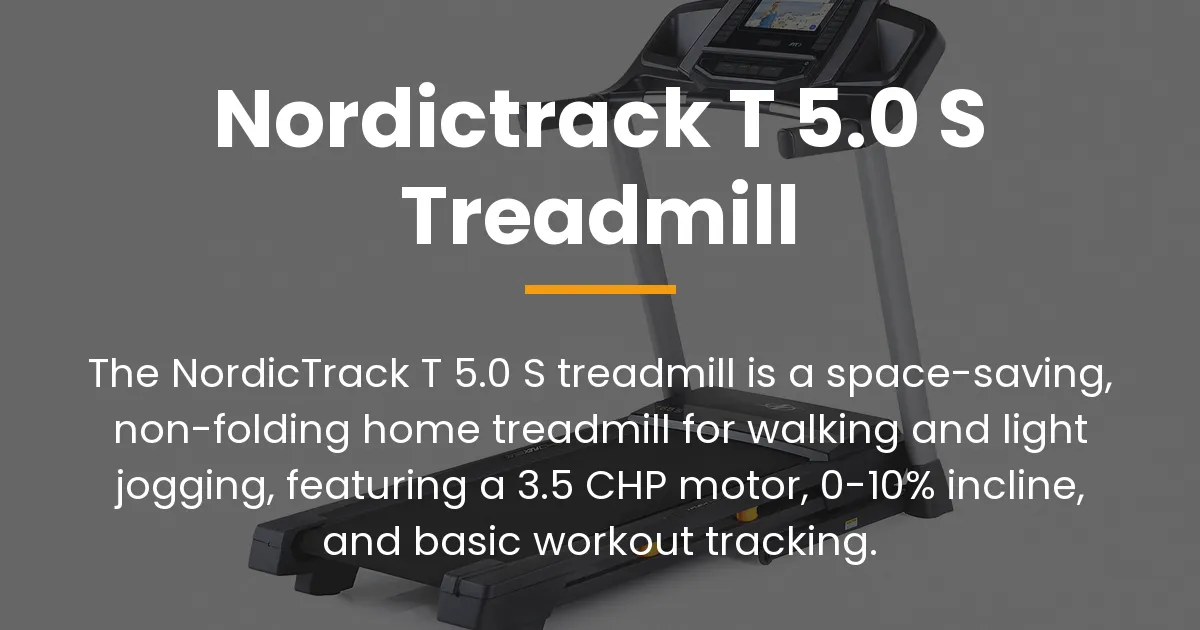
You want a straight number for treadmill power use. The direct answer is that most home treadmills draw between 600 and 800 watts when you are running. For the average user, this translates to a very manageable cost of about one to five dollars on your monthly electricity bill.
But that number is just the beginning. The horsepower rating on your machine’s motor is a massive source of confusion, often suggesting a much higher power draw that isn’t realistic. To truly understand your cost and your machine’s demands, you need to look past the label and see the real factors at work.
How Much Power Does a Treadmill Use
How much power does a treadmill use during a normal workout? The continuous power draw for a residential treadmill typically falls within a 600 to 700 watt range. This is the sweet spot for sustained running or brisk walking.
This wattage can shift significantly based on your activity. Walking at a gentle pace uses less energy, while pushing to a sprint or a steep incline demands much more from the motor.
The Standard Wattage Range
To give you a clearer picture, here is a breakdown of approximate power consumption across different workout intensities. Remember, these are averages and your specific machine may vary.
| Activity Level | Approximate Power Use (Watts) |
|---|---|
| Walking (2-3 mph) | 300 – 500W |
| Running (5-7 mph) | 600 – 800W |
| High-Intensity (Sprint/Steep Incline) | 900 – 1,500W+ |
These figures represent the actual draw from your wall outlet to keep the belt moving under load. They are far more useful for calculating your bill than the large horsepower number printed on the motor casing.
From Watts to Monthly Cost
Turning watts into dollars requires a simple universal formula. You will need three pieces of information: your treadmill’s wattage, how many hours you use it, and your local cost for electricity.
The formula is: (Watts ÷ 1000) × Hours Used × Electricity Rate ($ per kWh) = Total Cost.
Let’s walk through a typical example. Assume your treadmill uses 700 watts. You work out for 30 minutes a day, five days a week. That’s 2.5 hours per week. The national average electricity rate is about $0.17 per kilowatt-hour (kWh).
- Convert watts to kilowatts: 700W ÷ 1000 = 0.7 kW.
- Find monthly hours: 2.5 hours/week × 4 weeks = 10 hours/month.
- Calculate cost: 0.7 kW × 10 hours × $0.17/kWh = $1.19 per month.
As you can see, for most regular users, the direct electricity cost of running a treadmill is minimal. The real value of this calculation is in understanding your specific usage and ensuring your home’s electrical circuit can handle the load safely.
What Changes Treadmill Power Consumption
Several key factors make your treadmill’s power use go up or down. It is not just about speed. The actual physical work the motor must do is determined by two main forces.
User Weight and Belt Friction
Your weight is the primary load the motor must move. A heavier person requires more energy to keep the belt moving at the same speed compared to a lighter person. This is a direct physical principle.
Belt friction is the hidden factor. A poorly lubricated or misaligned belt creates massive resistance. The motor has to work much harder to overcome this sticky friction, which can spike power consumption unnecessarily. Proper maintenance is not just for longevity; it’s for efficiency.
Speed and Incline Settings
Increasing your speed or the incline level directly commands more power from the motor. Asking the machine to move the belt faster or to lift you against gravity requires a higher energy output.
This relationship is predictable. Doubling your speed does not necessarily double the power draw, but it will cause a significant increase. Similarly, adding incline is one of the most demanding settings for the motor, often pushing consumption toward the higher end of the wattage spectrum.
Treadmill Motor Labels Versus Real Energy Use
This is the most critical misunderstanding. You may see a label that says “3.0 HP Motor” and think it uses around 2200 watts continuously. This is not true. That horsepower rating indicates the motor’s peak, or maximum, output capability.
Think of it like the horsepower in your car. Your engine might be capable of 200 horsepower, but you are not using all 200 horsepower to cruise down a residential street at 35 miles per hour. The treadmill motor works the same way.
The continuous operating wattage is governed by the actual workload, which is your weight plus friction plus your chosen speed and incline. The large motor gives you headroom for starting up, handling heavier users, and providing a smooth experience at high settings without straining. Your actual power consumption is almost always far lower than the peak motor rating suggests.
Calculating Your Electricity Cost
To move from general estimates to your personal cost, you need to gather your specific details. This process eliminates guesswork and gives you a number tailored to your routine.
Finding Your Electricity Rate
Your electricity rate is listed on your utility bill, expressed as the cost per kilowatt-hour ($/kWh). Look for a line item that states the supply charge or energy charge. This rate can vary widely by state and local utility, so using your actual bill is crucial for an accurate calculation.
The national average is a helpful placeholder, but your rate could be significantly higher or lower. This single number has the biggest impact on turning your usage into a dollar amount.
A Detailed Cost Calculation
Let’s perform a detailed calculation using a specific scenario. Imagine you own a popular model like the Sole F80. You weigh 180 pounds, and you run at 6 miles per hour for 30 minutes a day, five days a week.
- Estimate Wattage: For this workout, a realistic continuous draw is about 750 watts.
- Convert to Kilowatts: 750W ÷ 1000 = 0.75 kW.
- Calculate Monthly Hours: 0.5 hours/day × 5 days/week × 4 weeks/month = 10 hours/month.
- Apply Your Rate: Assume your electricity rate is $0.20 per kWh (slightly above average).
- Final Cost: 0.75 kW × 10 hours × $0.20/kWh = $1.50 per month.
This step-by-step method shows how manageable the cost is for even dedicated runners. It also highlights that the biggest variable is often your personal electricity rate, not the treadmill itself.
Measuring Your Treadmill’s True Power Draw
Theory is useful, but actual measurement is definitive. The only way to know precisely how much power your specific treadmill uses in your home is to measure it directly with a simple tool.
You can buy a plug-in energy monitor, often called a kilowatt meter, for a very affordable price. This device sits between your wall outlet and the treadmill’s plug, tracking real-time power consumption.
Here is how to use it.
- Plug the kilowatt meter directly into your wall outlet.
- Plug your treadmill’s power cord into the meter.
- Turn on the treadmill and set it to your normal workout speed and incline. Use it for at least 5-10 minutes to allow the reading to stabilize.
- Observe the display on the meter. It will show the current wattage draw. This number is your machine’s true power consumption under those exact conditions.
This method cuts through all the marketing claims and generic estimates. It accounts for your weight, your machine’s unique friction, and even the efficiency of its motor. You get a concrete number you can confidently plug into the cost formula.
Reducing Treadmill Energy Use
While treadmill energy costs are low, efficiency is still a worthwhile goal. Small changes in maintenance and habit can reduce power draw and extend the life of your machine.
Maintenance for Efficiency
Regular maintenance is the most effective way to keep power consumption in check. A well-lubricated belt and a properly aligned deck drastically reduce the friction the motor fights against.
When friction is low, the motor does not have to work as hard to maintain your speed. This means it draws fewer watts from the outlet. Following your manufacturer’s lubrication schedule is not just a chore; it is a direct action to lower operating costs and wear.
Smart Usage Habits
Your habits outside of the workout itself also matter. The console and electronics use a small amount of standby power when the treadmill is plugged in but turned off.
If you plan to not use the machine for several days or more, such as during a vacation, unplugging it eliminates this phantom load entirely. For daily use, simply turning it off at the power switch is usually sufficient.
Also, consider consolidating your workouts. One 30-minute session uses less total energy than six separate 5-minute sessions because you avoid repeated startup cycles and extra standby time between uses.
Conclusion
Understanding how much power a treadmill uses means looking past the impressive horsepower label and focusing on the real-world factors you control. Your weight, your machine’s maintenance, and your workout settings determine a realistic wattage between 600 and 800 for most runs.
With a simple formula and possibly a cheap meter, you can translate that into a precise monthly cost, which for almost everyone is just a few dollars. By keeping the belt lubricated and being mindful of standby power, you can ensure your home fitness journey is both effective and efficient.
Frequently Asked Questions
Does using the handrails increase power consumption?
No, using the handrails does not increase power consumption. In fact, if you lean heavily on the rails, you reduce the effective weight the motor must move, which could slightly decrease power use. However, this defeats the purpose of your workout.
Is it more energy-efficient to run at a high speed for a short time or a moderate speed for longer?
For total energy use, a shorter, more intense workout will consume slightly less electricity overall because the motor runs for less time. However, the difference in cost is negligible—likely just pennies per month. Focus on the workout that meets your fitness goals.
Should I unplug my treadmill when not in use?
It is a good practice if you will not use it for several days or more, like during a long trip. This stops all standby power use. For daily use, simply turning the power switch off is sufficient, as the phantom load from the console is very small.
Can a treadmill trip a 15-amp circuit breaker?
Yes, it is possible, especially on a shared circuit. A 15-amp circuit can safely handle about 1800 watts. A treadmill starting up or running at high incline could draw over 1000 watts. If other devices like lights or a TV are on the same circuit, the combined load may trip the breaker. Use a dedicated outlet if possible.
How does a treadmill’s power use compare to other home gym equipment?
A treadmill is typically a mid-range consumer of electricity. An elliptical or exercise bike usually uses less power, often between 200-500 watts. A high-end rowing machine might be similar to a treadmill. Large equipment like a powerful stationary bike with a heavy flywheel or an electric stair climber can use as much or more.
Does a manual treadmill use any electricity?
A true manual treadmill, also called a curved non-motorized treadmill, uses no electricity at all. Your leg power moves the belt. Any console or display on it would require batteries or a plug, but the belt mechanism itself is human-powered.
Will a solar panel system significantly offset treadmill energy costs?
The treadmill’s cost is so low that a solar panel system would offset it easily, but that’s not a primary reason to install solar. The system would be designed to power your entire home, with the treadmill representing a tiny fraction of that total load.
Does a warmer or colder room affect treadmill power usage?
Ambient temperature has a minimal direct effect. However, extreme cold might make the belt and lubricant slightly stiffer at startup, causing a brief, slight increase in initial power draw. Once running, the effect is negligible.
Do more expensive treadmills use less electricity?
Not necessarily. More expensive models often have more powerful motors for smoother operation and higher user weight limits. However, they may also have better engineering and components that can operate efficiently under load. The actual power draw will still depend primarily on your weight and workout intensity.
How does incline training affect the electricity bill?
Incline training significantly increases power consumption because the motor must work against gravity to lift your weight. Using a steep incline can easily double the wattage compared to running on a flat setting. This will increase your cost proportionally, though it will still likely only add a dollar or two to your monthly bill for typical use.