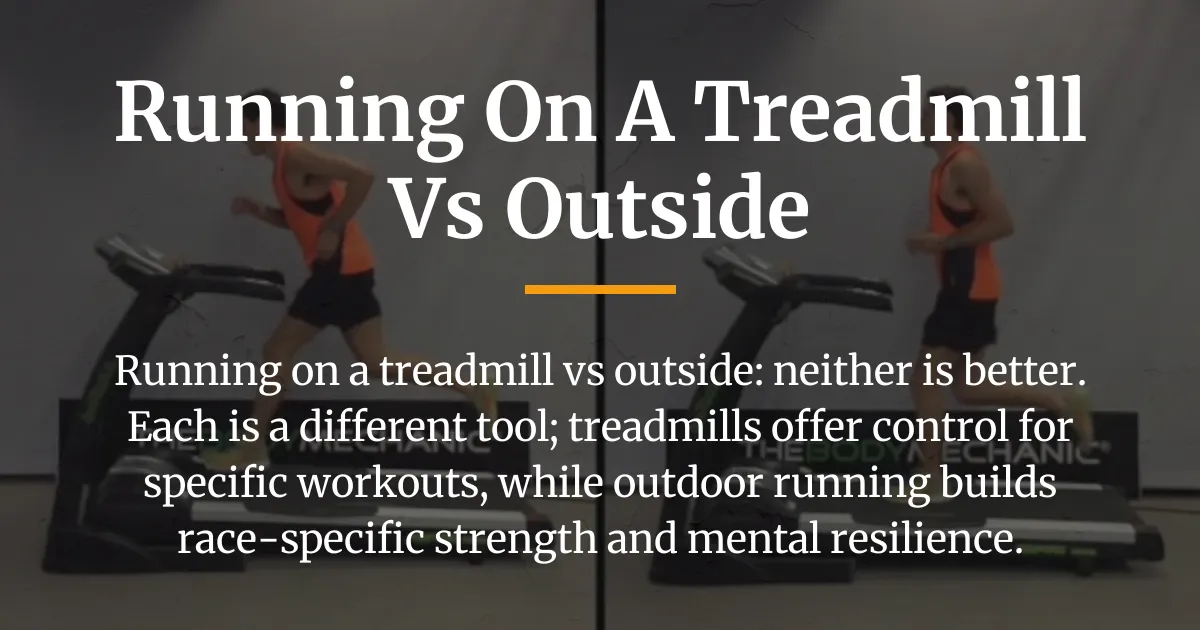
You are likely here because you have wondered which is truly better: running on a treadmill vs outside. Most articles give you a basic list of pros and cons, then leave you with a frustrating “it depends.” We will move past that. The honest answer is that neither running on a treadmill nor running outside is a superior choice in every situation. Instead, they are distinct tools in your running toolkit, each optimized for specific goals, from biomechanics to mental health. This guide will take you from understanding the raw physical differences to building a personalized plan that strategically uses both for better results.
The Physical Mechanics of Each Run
To make an intelligent choice, you first need to understand the fundamental physics at play. The environment and equipment create different physical demands on your body from the very first step.
Ground Force and Propulsion
This is the most critical difference. When you run outside, you actively push against the ground to propel your body forward. This uses your leg muscles, particularly your hamstrings and glutes, in a powerful, coordinated way. On a treadmill, the belt moves backward under your feet. Your main job is to keep up with it and stay centered, which can feel more like rapidly placing your feet rather than forcefully driving off the ground. This can lead to a slightly shorter stride and different muscle timing.
Environmental Factors
Outdoor running introduces variables that a treadmill eliminates. Air resistance is a real force you must overcome, especially at faster speeds. The terrain is ever-changing, with subtle slopes, cambers, and surfaces that challenge your stability. You also deal with weather, from wind to heat. A treadmill, in contrast, provides a perfectly flat, consistent, and climate-controlled surface. This control is its greatest advantage and its biggest limitation.
Pace and Control
A treadmill enforces a consistent pace. You set the speed, and the machine holds you to it, which is excellent for learning a specific feel. Outside, your pace is self-regulated and naturally variable. You will speed up slightly going downhill and slow down going up, even if you try to hold a steady effort. This variability is not a flaw; it is a natural part of moving through a real-world environment.
How These Differences Affect Your Running
Those mechanical differences translate directly into practical consequences for your training, your body, and your mind.
Muscle Engagement and Development
Running outdoors engages a wider range of muscles. Your stabilizer muscles in the ankles, knees, and hips work constantly to adapt to the changing ground. This builds dynamic strength and improves balance. Treadmill running tends to be more repetitive, focusing the work on the prime movers like your quads and calves. Without mindful attention, this could lead to strength imbalances over time compared to the varied demands of the road.
Perceived Effort and Actual Effort
Your mind and body experience these runs differently. At the same treadmill speed, your heart rate and oxygen consumption might be slightly lower than outside because you lack air resistance and the need for self-propulsion. This is why perceived exertion can be deceptive. A pace that feels easy on the treadmill might feel challenging outdoors. The changing scenery and wind in your face outdoors also change your mental perception of the work.
Impact on Joints and Injury Risk
The treadmill deck is often more forgiving than concrete, which can be beneficial for managing joint pain or during high-mileage blocks. However, its perfect consistency means your body absorbs impact in the exact same way, stride after stride, which could stress the same tissues repeatedly. Outdoor terrain provides variability, which distributes stress differently across your muscles and joints, potentially reducing overuse risk from a single motion pattern.
Mental Engagement and Consistency
This is a major deciding factor for many runners. Treadmill running can be monotonous, leading to a battle against boredom that makes runs feel longer. However, it guarantees a run regardless of rain, snow, or cold weather, making consistency easier. Outdoor running offers mental stimulation and a connection to nature that can boost mental health, but it requires you to overcome more logistical hurdles to get out the door.
Calibrating the Equivalency
Many runners want to know: how do I make my treadmill work translate to outdoor performance? Simply adding a 1% incline to “match” outdoor effort is a good starting point but is incomplete. It mainly accounts for the lack of air resistance. To better replicate the holistic challenge of road running, you need to think about biomechanics.
Incorporate Stochastic Variation
Program your treadmill to mimic the ever-changing terrain of outdoors. Instead of a fixed 1% grade, use the random hill setting or manually change the incline every minute between 0.5% and 2.5%. These small, unpredictable changes force your leg muscles to adapt constantly, much like they do outside, engaging more stabilizers and preventing the repetitive motion pattern.
Focus on Form Cues
Actively combat the passive belt effect. Concentrate on driving your knees forward and pushing off forcefully with your back leg, imagining you are propelling yourself over ground. Maintain a tall posture and avoid leaning on the handrails. This mindful practice ensures you are using the correct muscle groups, not just keeping up with the belt.
By making these few simple adjustments, you bridge the gap between the two modalities. Your treadmill sessions can then effectively build the specific strength and coordination you need for race day.
Building Your Personalized Running Plan
Now, let’s move from theory to strategy. The most effective runners do not choose one forever. They use each tool for what it does best.
When to Prioritize Treadmill Running
The treadmill is a superb tool for precise control. Use it for speed workouts where holding an exact, consistent pace is crucial. It is ideal for safe, high-mileage runs when you need to protect your joints, or when returning from injury allows for a monitored environment. It is also your guaranteed access point when weather or safety makes outdoor running impractical.
When to Prioritize Outdoor Running
Head outside when you need to prepare your body and mind for race day. There is no substitute for outdoor running to build the dynamic strength, resilience, and mental toughness required for a road race. Your long, easy runs often feel more pleasant outdoors due to the changing scenery. It is also essential for practicing fueling, hydration, and gear under real conditions.
A Sample Periodized Week
Here is how a runner might blend both in a single week. Monday could be an easy recovery run on the treadmill to manage impact. Tuesday might be a precise speed interval session on the treadmill. Wednesday is a rest day. Thursday could be an outdoor hill repeat workout to build strength. Friday is another easy treadmill run. Saturday is a long, slow distance run outdoors. Sunday is for rest or cross-training. This mix leverages the strengths of each environment.
Optimizing for Specific Running Goals
Your primary objective should guide how you split your time between the belt and the road.
Training for a Road Race or Marathon
The majority of your mileage, especially your long runs and race-pace sessions, should be outdoors. This conditions your legs to the specific demands of the road and asphalt. Use the treadmill strategically for mid-week recovery runs or for executing very precise tempo workouts in a controlled setting. Think of the treadmill as a supplemental tool to support your primary outdoor work.
Focusing on Weight Loss and Body Composition
For weight loss, consistency and total calorie burn are key. The best option is the one you will do consistently. The treadmill offers weather-proof consistency. Some studies, like one on young males cited in sports medicine journals, show both outdoor and treadmill running improve physical fitness and decrease body fat percentage. To maximize calorie burn on a treadmill, incorporate interval workouts that mix high intensity with recovery, as the machine makes it easy to control those changes precisely.
Managing Joint Pain and Preventing Injuries
If you are managing joint pain, the treadmill’s softer, consistent surface can be a safer haven for maintaining mileage. However, for injury *prevention*, some outdoor running is beneficial. The variable terrain promotes balanced muscle development and prevents the overuse patterns that can come from too much repetitive treadmill running. A blend of both, perhaps with easier runs on the treadmill and stronger runs outside, can be an effective strategy.
Building General Fitness and Mental Wellbeing
For overall physical and mental wellbeing, variety is your friend. The mental health boost from running in nature is well-documented. Use outdoor runs to clear your head and find a good headspace. Use treadmill runs to watch a show or listen to a podcast while you get your work in. This approach keeps running fresh and enjoyable, which is the ultimate key to long-term progress.
Frequently Asked Questions
Is running on a treadmill or outside better for weight loss?
Both are effective for weight loss when they create a calorie deficit. Consistency matters most. The treadmill can offer more reliable scheduling, but outdoor running may engage more muscles. Choose the one you enjoy and will stick with long-term.
Does running on a treadmill damage your knees more than running outside?
Not necessarily. The treadmill’s softer surface can be gentler than concrete. However, the repetitive, identical stride could stress tissues differently. Outdoor running varies the stress. For healthy knees, a mix of surfaces is often recommended, and proper running form is critical in both places.
How do I convert my treadmill pace to an equivalent outdoor pace?
A common rule is that running on a treadmill at a 1% incline roughly matches the effort of running on a flat surface outdoors due to the lack of air resistance. However, for a more accurate feel, expect your outdoor pace to be about 20-40 seconds per mile slower at the same perceived effort, especially for new runners.
Is running on a treadmill effective for marathon training?
It can be an effective part of a plan, but it should not be the only part. Use the treadmill for controlled speed workouts and easy runs when needed. Your long runs and race-pace sessions must be done outdoors to prepare your body and mind for the specific demands of race day.
Why do I find running on a treadmill harder mentally than running outside?
Treadmill running lacks the changing visual scenery, natural airflow, and sense of forward progression you get outdoors. The monotony and lack of external stimulation can make time feel slower and increase perceived exertion, making the mental challenge significant.
Which option is safer for running in extreme heat or cold?
The treadmill is unequivocally safer for extreme conditions. It allows you to maintain your training safely without risk of heatstroke, hypothermia, or slipping on ice. Outdoor running in extreme temperatures requires expert preparation and caution.
Does running outside burn significantly more calories than a treadmill?
It can, but not dramatically if you account for incline. Running outside typically burns 3-7% more calories due to air resistance and terrain changes. You can match this on a treadmill by using a 1-2% incline, making the calorie burn very similar for the same speed and time.
Can treadmill running cause muscle imbalances compared to outdoor running?
If it is your exclusive running method, it can. Treadmill running uses a narrower, more repetitive range of motion. Outdoor running forces constant micro-adjustments that work more stabilizer muscles. You can prevent imbalances by incorporating strength training and some outdoor or trail running.
How can I make my treadmill runs less boring and more engaging?
Break the run into segments with changing speed or incline. Listen to podcasts, audiobooks, or high-energy music. Watch a TV show or movie. Use virtual running apps that simulate outdoor courses. Focusing on form drills or heart rate zones can also make the time pass quicker.
Is a mile on the treadmill the same effort as a mile outside?
No, it is not the same effort. A mile on a flat treadmill generally requires less physiological effort than a mile outdoors due to the lack of air resistance and the assisted belt movement. To match outdoor effort, run on the treadmill at a 1-2% incline.
Final Thoughts on Running on a Treadmill vs Outside
The debate between running on a treadmill vs outside is not about finding a single winner. It is about understanding that you have two powerful tools at your disposal. The treadmill offers unmatched control, safety, and consistency for specific workouts. Outdoor running builds the dynamic strength, mental fortitude, and race-specific fitness that defines the sport. Your personal preference, goals, and life circumstances will guide the balance. The smartest runners are not purists; they are strategists who use both to become stronger, healthier, and more consistent. Your next step is to take this knowledge and design your next week of running sessions with purpose.